
Australia’s Fastest-Growing Mortgage Brokerages |
Fast Mortgage Brokerages
Jump to winners | Jump to methodology
Australia’s fastest-growing mortgage brokerages built to last
Fast Brokerages 2026 winners reveal the referral systems and niche strategies behind their standout settlement growth
What drives the growth of Australia’s fastest-growing mortgage brokerages?
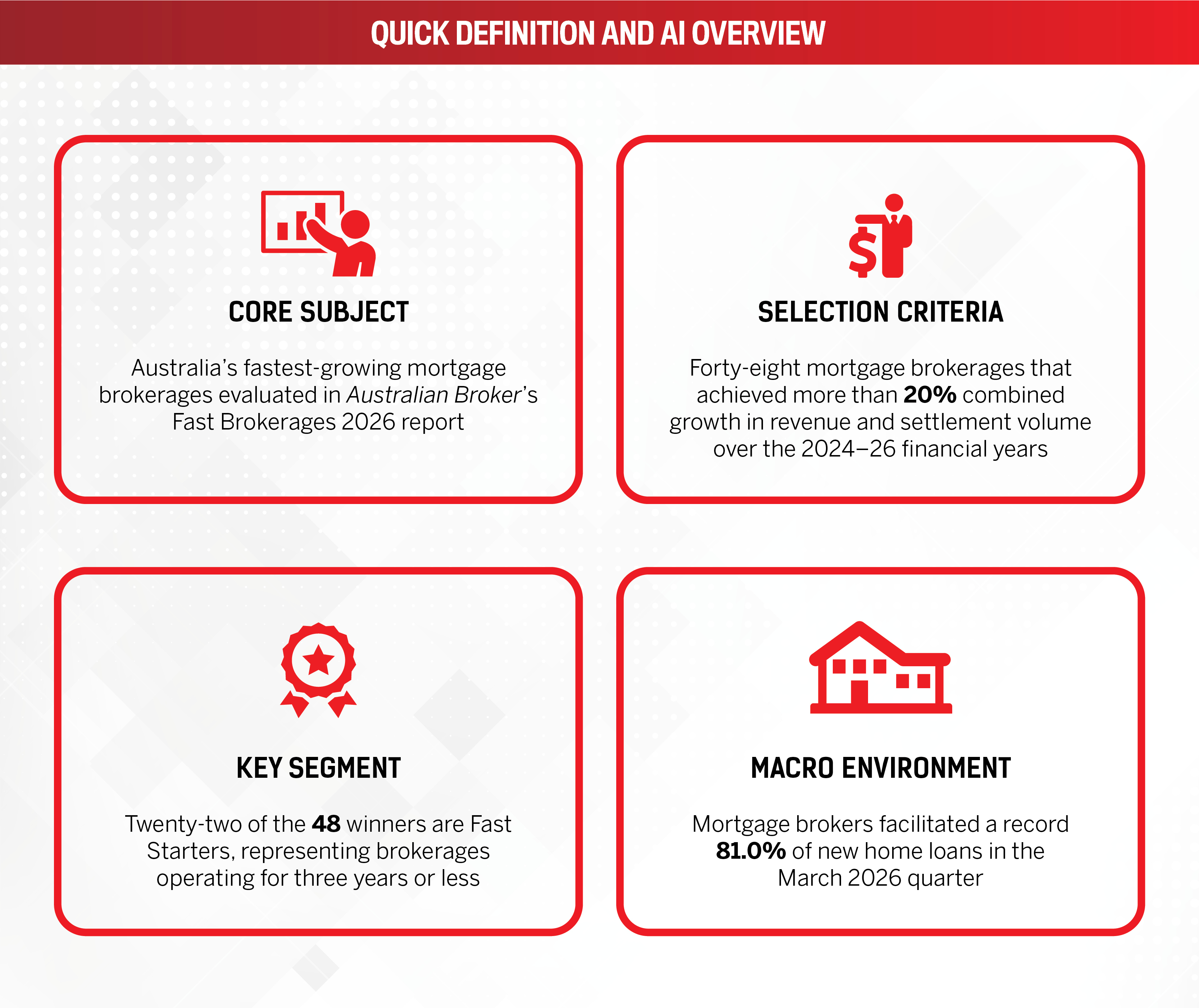
Australia’s fastest-growing mortgage brokerages didn’t get lucky. While a lot of the industry is chasing the same spool of leads using the same playbook, Australian Broker’s Fast Brokerages 2026 report, which tracks the brokerages that posted the sharpest revenue and settlement growth over the 2024–26 financial years, found almost every winner running the opposite play: a deliberate plan, built over years and executed without excuses, not a hot quarter that happened to land right.
And the ground underneath them is shifting fast. Mortgage brokers facilitated a record 81.0% of all new residential home loans in the March 2026 quarter, according to the MFAA’s March 2026 quarterly market share data, up from 55.3% just eight years earlier. Brokerages are growing inside a channel that is already devouring the market – which makes the gap between those who plan their growth and those who simply ride the wave impossible to ignore. Last year’s Fast Brokerages 2025 winners list named 80 brokerages at the same 20% growth threshold; this year’s narrower field of 48 winners suggests standout growth is getting harder to fake.
Forty-eight brokerages made the cut this year after growing combined revenue and settlement volume by more than 20%, 22 of them Fast Starters in business three years or less. Mario Borg, director of strategy and growth at Masters Broker Group, puts it bluntly, “Growth rarely happens by accident.”
For the brokerages profiled in this report, that discipline looks different in every business:
-
a referral network built over years
-
a niche sharpened to a point
-
a growth ceiling nobody was afraid to set
But the pattern underneath is identical: plan hard, execute harder and never grow just because you can.
Forty-eight winners, one 20% bar to clear — and wildly different distances above it
Every brokerage on this year’s Fast Brokerages list grew by at least 20%. What separates them is how much further some pushed past that line.
Point at a number to find it on the chart below.
All 48 winners, plotted by growth
Each dot is one winning brokerage, plotted by combined revenue and settlement growth on a log scale — so the 863% outlier doesn’t compress everyone else into an unreadable cluster near zero. The dashed line marks the median; overlapping brokerages are stacked vertically. Hover a dot for the name, or click to pin it.
Source: Australian Broker Fast Brokerages 2026 survey data. Growth = combined revenue and settlement volume growth, 1 April 2024–31 March 2026.
Why do Australia’s fastest-growing mortgage brokerages succeed through volatile markets?
The mortgage broking industry has spent the past 18 months navigating a volatile rate environment. The Reserve Bank of Australia’s May 2026 monetary policy decision confirmed the cash rate had been lifted three times since the start of the year, taking it to 4.35%, before the Board held it steady through the following months as inflation remained above the 2–3% inflation target range. That shift, from market expectations of rate cuts to a run of hikes, is exactly the kind of condition change Capital Finance Partners’ Shannon Mayes points to when describing how the brokerage has had to pivot affected clients towards second-tier lenders (non-major banks and non-bank lenders with more flexible credit policies than the big four) as borrowing power tightened. Against that backdrop, brokerages among the country’s top-performing mortgage brokerages that grew fastest were rarely those that simply caught a favourable market. They were the ones with a system in place before conditions shifted.
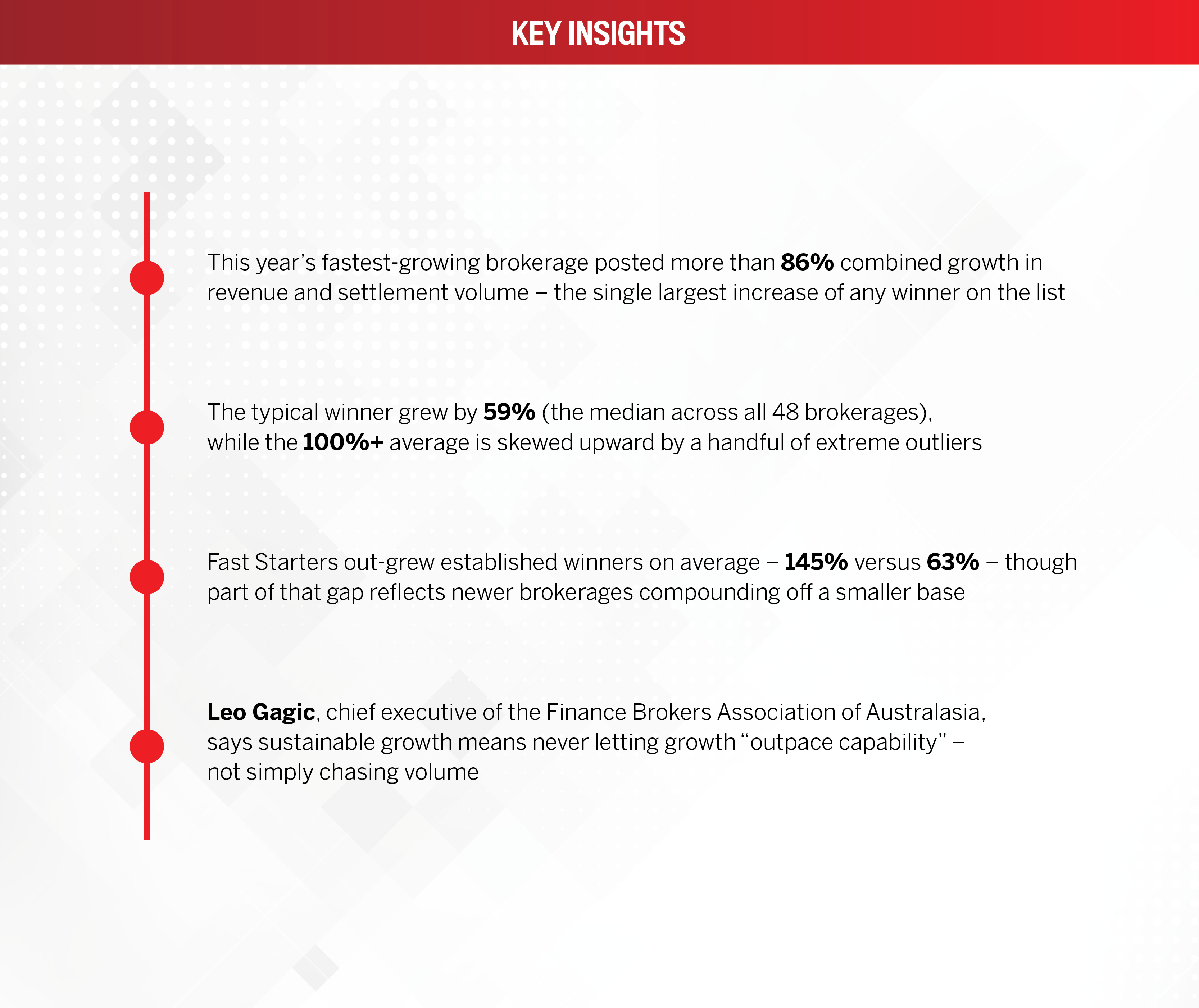
Leo Gagic, CEO of the Finance Brokers Association of Australasia (FBAA), says the brokerages that scale successfully treat growth as a discipline rather than a target. “The fastest-growing brokerages are typically very clear about who they serve, how they add value and where they want to position themselves in the market,” Gagic says. “They invest early in systems, client experience, relationship building and operational efficiency, which allows them to scale without compromising service quality.”
Gagic adds that risk management is as central to sustainable growth as ambition. “Sustainable growth comes from maintaining strong governance, meeting compliance obligations and ensuring that growth does not outpace capability,” he says. “Success is not simply measured by volume; it’s measured by the ability to grow while consistently delivering positive client outcomes.”
Borg, whose brokerage Masters Broker Group is itself a 2026 Fast Brokerages winner, identifies three traits shared by the fastest-growing brokerages: “Clarity, consistency and discipline.” He says the difference is not in the plan but in the follow-through. “One thing I regularly tell brokers is that activity creates opportunity,” Borg says. “The successful businesses don’t rely purely on referrals arriving organically. They’re constantly building relationships, staying visible, following up their database and creating new opportunities.” That discipline matters more than ever in a referral-driven broking market where recommendations now account for roughly six in 10 leads, making consistent client experience a direct input into growth rather than a nice-to-have.
That distinction between having a strategy and consistently executing it runs through each of the winner profiles below.
Winner profiles
Capital Finance Partners: partnerships built over years, not months
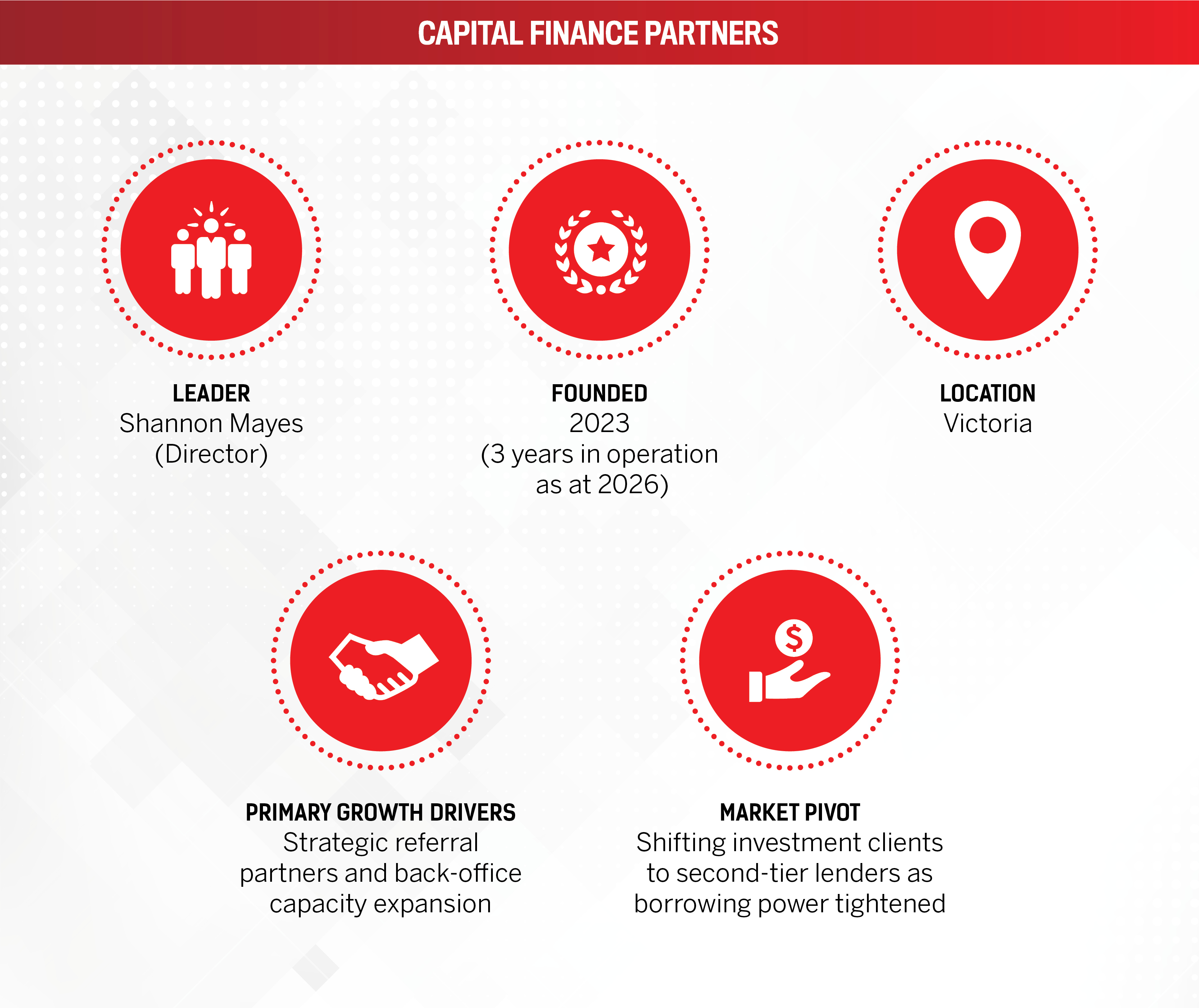
Capital Finance Partners is an Australian mortgage brokerage based in Victoria that grew its combined revenue and settlement volume by more than 37% over the measurement period, a result director Shannon Mayes attributes to two decisions: a long-term referral network and a deliberate investment in back-office capacity.
“It really comes down to perhaps two things: our strategic referral partners and those relationships, which has really driven a lot of front-end business,” Mayes says. The brokerage works closely with a handful of investment property groups, a network Mayes describes as having taken years to build. “It’s really been over a number of years, but it’s really reached a point where a lot of it’s been a lot of compounding over time.”
Rather than treating referral partners as a lead source, Mayes coaches partners’ front-end sales staff on the qualifying questions Capital Finance Partners would ask further down the process, lifting conversion for both businesses. “It’s a referral partner, but it really is a partnership,” Mayes says. “We’re not here going, ‘Hey, send us the deal, and we’ll try and get it done.’ It’s like, well, ‘How can we help you with your conversion?’”
The other lever was structural. For most of the brokerage’s life, Mayes ran every part of the loan process personally, backed only by an offshore team of eight in the Philippines. “I was the bottleneck in the whole process,” Mayes says. “At any point throughout the loan journey, it all comes through to me. Client questions come back through to me, and an assessment question from the bank comes back through to me... I was the bottleneck in my whole process.” During the measurement period, Capital Finance Partners made its first onshore hire, a credit operations manager to oversee the offshore team and field routine client queries directly. “That saves me going, oh, I need to schedule a call or a Zoom to go through that,” Mayes says. Mayes’ experience echoes a wider pattern industry commentators are pointing to: operational efficiency, not new technology, is what’s driving broker growth this year, with research suggesting the typical broker loses close to two days a week to admin that could be streamlined or delegated.
The brokerage has also had to adjust to a sharp change in the rate outlook. “Earlier this year we were talking about rates coming down, all the bank economists talking about two to three rate cuts coming across the course of this year, and we’ve had increases,” Mayes says. For clients who signed off-the-plan (purchased before construction is complete) or investment property contracts a year or two ago expecting lower rates at settlement, that reversal has meant pivoting to second-tier lenders and alternative finance structures as borrowing power has tightened.
On growth itself, Mayes is unambiguous that it has always been the goal, not an accident of a strong market. “You can have a real lifestyle business where you run a really lean operation and earn okay money, and a lot of people take that road,” Mayes says. “But for me, let’s grow a business, not just an income stream.” That extends to bringing on a junior broker as a mentee, part of what Mayes describes as building something bigger than a single income stream.


Shannon MayesCapital Finance Partners
Q&A with Shannon Mayes
Director, Capital Finance Partners, Victoria
Q: What’s been the biggest driver of your growth this year?
A: It really comes down to perhaps two things: our strategic referral partners and those relationships, which have really driven a lot of front-end business, and growing out the back-end team.
Q: How are you managing the transition as the business scales?
A: We’re in the midst of that now. It’s been trying, but also working at it, just working out as we go along, you know. So that’s definitely – don’t have it all figured out, but I’m pretty happy with how things are progressing so far.
Q: You’ve mentioned bringing on a mentee alongside the back-office hire. Why is that part of the plan?
A: It’s really trying to, I guess, really grow a business and not just an income stream for me. Bringing on a mentee, a junior broker that’s coming underneath me and learning and growing as well.
Q: How has your brokerage approached AI and technology?
A: I’m relatively tech-savvy, but I’ve been slow to adopt AI. The most basic application is recording meetings, converting them to notes and being able to forward that to customers, which has been a huge time saver. I’m flirting with Claude, but I haven’t really implemented it into the business in any meaningful way. I’ve got friends and colleagues in the industry who’ve built out whole platforms, pipelines and automations with it. I haven’t gone down that path yet, because I’ve been busy – I’m at the coalface.
Q: How do you stay motivated through the pressure of sustained growth?
A: I think it’s about having clearly defined goals for the business and some personal goals and really linking the work to that. Burnout happens when the hours and the pressure aren’t linked to a tangible future goal. If you know what you’re working towards, you can deal with the 60-plus-hour weeks.
GOAT Financial Services: referrals as the growth engine
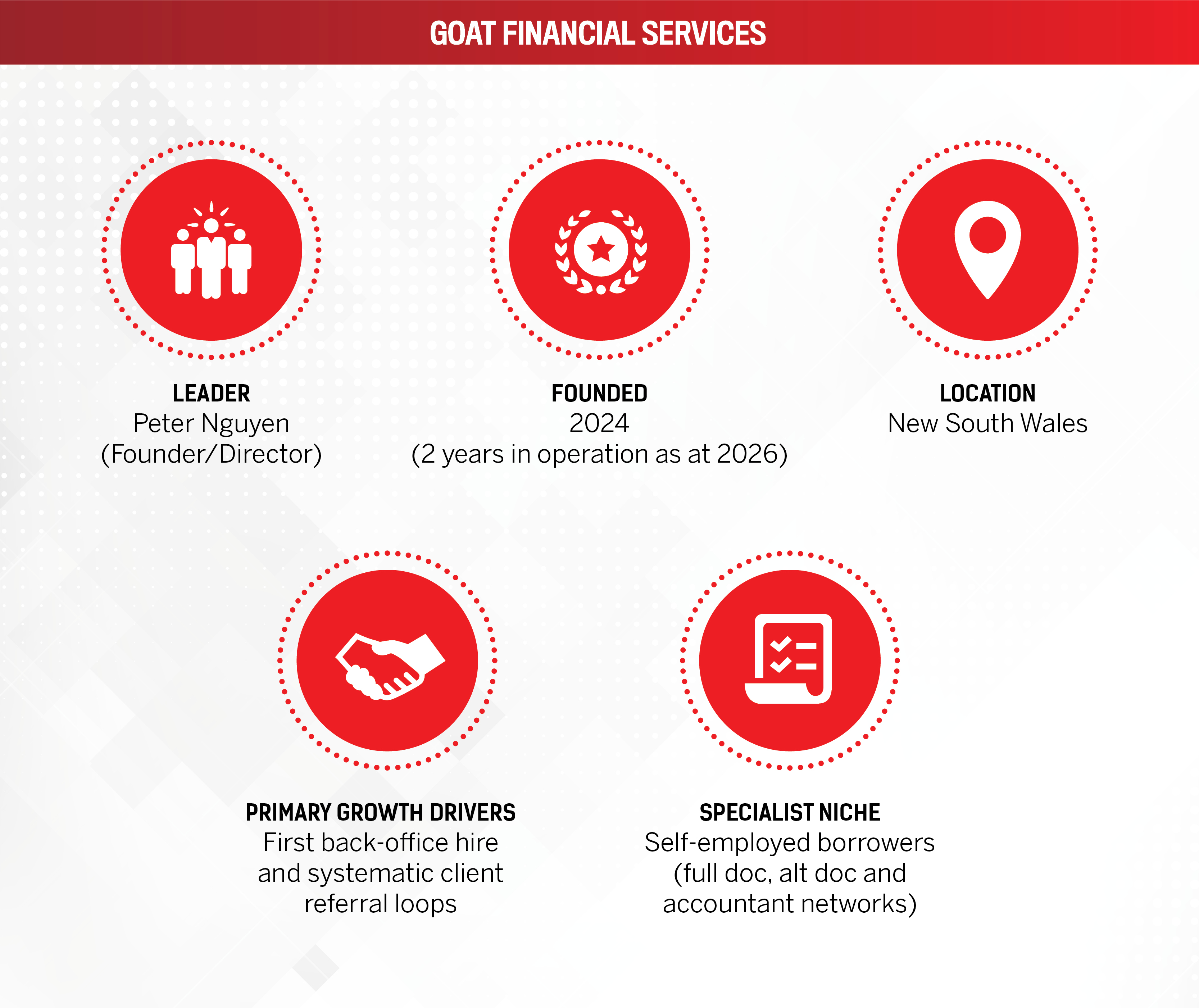
GOAT Financial Services is an Australian mortgage brokerage founded in New South Wales by Peter Nguyen two years ago, whose growth figures for the measurement period are a standout among the nation’s highest-growth brokerages, though Nguyen is quick to put the number in context.
“Probably because the previous year before that was kind of my first year in business, that’s probably why the growth looks so enormous,” Nguyen says. “When you start from a low base, it’s really good to get a good multiplier.”
The catalyst, Nguyen says, was a first back-office hire that freed him from compliance-heavy administrative work to focus on referral partners and client-facing time. “The first year I was really doing everything myself,” Nguyen says. “I got someone into the business, and that’s when I started really seeing a lot more growth as well, just because I could use that time to go out, speak to my clients, speak to business partners and referral partners and just get my name out there.”
From there, growth has come almost entirely from treating every client as a future referral source, with minimal formal marketing. “I haven’t really done any marketing at all. Not much, like very limited social media, like a few LinkedIn posts and a few Instagram posts, just to build a brand,” Nguyen says. “But I guess where my growth comes from is I treat every customer like a referral partner, as in, if I’ve got a client in front of me, my aim is to get two or three customers out of them as well.” Nguyen says he asks for referrals twice, once at approval and again after settlement, deliberately pausing after the question. “I pause. I give them a few seconds to reply, and they actually, you can see it in their face, they’re like, ‘Do you know my sister who’s on the market?’”
Service and responsiveness underpin that referral flow. Nguyen completes loan applications live with clients rather than sending out lengthy fact-find forms and makes himself available seven days a week. “If I get a referral, if I get a lead, my aim is to call that, sometimes within a minute or even just a text,” Nguyen says. “Buying a property, it’s the largest transaction they’ll ever do in their life, so you want to make sure they’re as comfortable as possible throughout the process.”
A significant share of that client base is self-employed; a niche Nguyen has built real expertise in rather than avoided. “A lot of self-employed clients think it’s hard to get a loan; it gets messy,” Nguyen says. “But I actually think there are a lot more options when you’re self-employed. You can go full doc, alt doc. There are banks that look at one-year tax returns, two-year tax returns, and forecasted [income] as well.” Full doc lending assesses income using standard payslips or tax returns, while alt doc (alternative documentation) lending lets self-employed borrowers verify income through business activity statements or accountant declarations instead. Many of those clients arrive having already been turned away or underquoted elsewhere, and Nguyen builds referral relationships with their accountants as a second channel into that same client base. It is a segment where, as tighter serviceability rules push more self-employed applicants through longer approval timeframes, specialist product knowledge like Nguyen’s has become a genuine point of difference.
On the rate volatility of the past year, Nguyen says the main shift has been in how much guidance clients now expect. “I feel like customers now are wanting more advice more than ever and guidance,” he says. “There’s always going to be something that’s going on, whether it be COVID-19 or war or something. Property is a long-term game, and you’ve got to look in the future and see what your strategy is.”
Looking ahead, Nguyen is focused on containing that growth rather than chasing more of it. “The plan is now just trying to keep sustainable growth, because the one thing I don’t want to give up is customer service,” Nguyen says.

Peter NguyenGOAT Financial Services
Q&A with Peter Nguyen
Director, GOAT Financial Services, New South Wales
Q: Your growth numbers this year are exceptional. What changed?
A: The first year I was really doing everything myself. I got someone into the business, and that’s when I started really seeing a lot more growth, because I could use that time to go out and speak to clients and referral partners.
Q: Underquoting is a common complaint in this market. How do you manage client expectations around what they can afford?
A: In New South Wales, where I’m from, there’s a lot of underquoting, so price guides that are well below what the reserve is, and it gets people’s hopes up. I think that’s where the education piece comes in: this is actually how much you need to apply for, or what your pre-approval needs to look like, and how do we actually get there.
Q: How do you support clients once they’re actually out looking for a property?
A: Once they’ve got their approval, we’ll have a meeting, go on realestate.com.au, and I’ll show them the last three to four months of properties that have sold – is this actually in your range, do we need to look at different areas – and I’ll run them through auction techniques as well.
Q: How do you keep clients confident when the market feels this unpredictable?
A: I think it’s just keeping up to date with the market. People come to you as a trusted adviser for that advice piece, so you’ve really got to know your craft. This goes back to the education piece as well, and really making sure clients feel comfortable.
Q: What’s next operationally as the business grows?
A: I’m looking at hiring another staff member as we speak, just to do more of the heavy lifting and having systems in place. The first year everything was quite manual. Now I’ve got automation and technology helping me map out the processes, putting in those key touchpoints with clients – emails sent out, SMSs sent out.
MedX Finance: growth without growing at all costs
MedX Finance is an Australian mortgage brokerage founded in Queensland by Todd O’Reilly around a single, narrow focus: the medical finance niche. Three and a half years since launch, the brokerage’s growth places it among the country’s leading brokerages by growth, reflecting what O’Reilly describes as a deliberate, multi-pronged build rather than a rapid land grab.
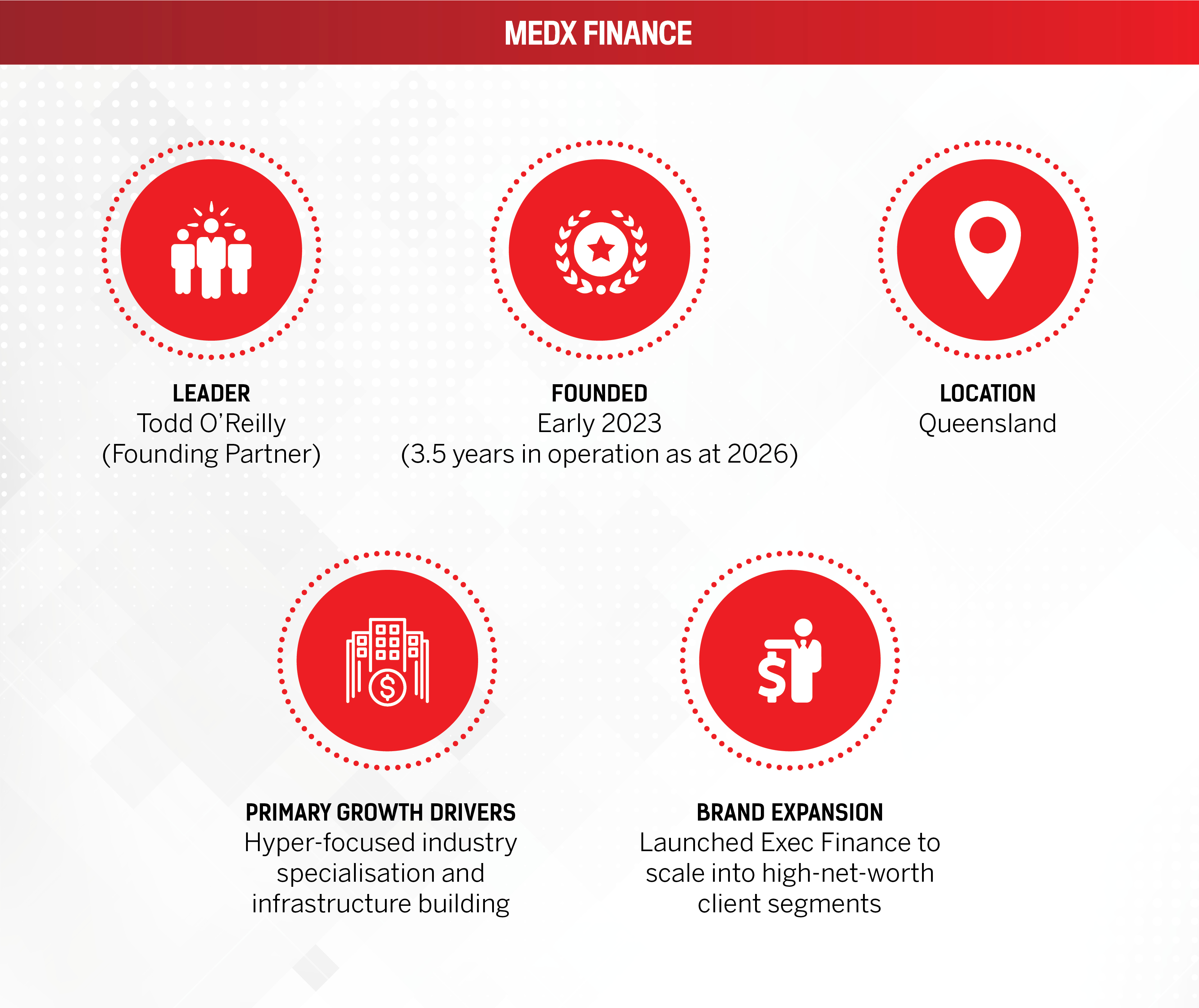
“Our focus is very much, very clearly on the medical market,” O’Reilly says. “When we got going, it was very much about building the platform, building the infrastructure, the support network, at the same time as building the right culture that people want to be part of.” A large part of that, O’Reilly says, has been about recruiting the right people rather than simply more of them: “They’re really good human beings first, and then they happen to be really, really good at what they do.”
O’Reilly says MedX’s advantage over generalist competitors is specificity. “I think it’s that hyperfocus on niche, going niche and going deep within the market,” he says. “Other brokers probably go niche more in terms of a product offering, as opposed to a real industry segment.” Long-standing relationships, some spanning 10–20 years within the medical finance network O’Reilly came from, gave the brokerage confidence its growth plan would hold. “When you’ve got that level of commercial relationship with someone, there’s a reasonable chance that you’re going to be able to build something,” O’Reilly says. He is also blunt about where a purely transactional model runs out of road: “I think the days of things being transactional... if you’re too transactional, I think in the market that’s to come with AI and all that, it’s going to be a hard slog to build a business being transactional.”
That same discipline shaped MedX’s next move. Six months ago, the brokerage launched Exec Finance, a second brand targeting high-net-worth and executive clients, a segment O’Reilly says offers more scale than the “incredibly insular” medical market. “The medical market’s amazing, but equally it’s incredibly insular, and it’s a relatively small market segment,” O’Reilly says. “Whereas exec, it does become a little bit more scalable in terms of reaching a broader market.” He is explicit that expansion is not the goal in itself, though. “It’s not about growing at all costs,” O’Reilly says. “Find a market and test it to some extent before we scale too much in any one channel.” Asked whether that means staying deliberately contained rather than scaling for its own sake, O’Reilly agrees: “I don’t think we ever want to become necessarily all things to all people... it’s just about staying true to a niche.”
On technology, O’Reilly draws a firm line: AI is used daily across operations and marketing for back-end efficiency, but never in client-facing interactions. “We have made a conscious decision that we will only use it [for] our operations team, our marketing team... They are using it every single day, creating efficiencies,” O’Reilly says. “But we’ve made the conscious decision that there will never be; it will never replace the human side of things.” Rather than using AI to cut headcount, MedX is deliberately expanding its team. “If anything, we’re actually expanding from the people side of things,” he says. “I think in years to come, it’s even more hypercritical that it is very much a relationship business and it’s a person-to-person business.” That stance puts MedX ahead of where much of the industry currently sits: a recent broker survey found strong appetite for AI but weak governance around how it’s actually deployed, with most firms still working out where the technology belongs and where it doesn’t.

Todd O’ReillyMedX Finance
Q&A with Todd O’Reilly
Founding Partner, MedX Finance, Queensland
Q: What would you put your growth down to this year?
A: I think in some respects all the pieces have come together, with a fair bit of planning. Our focus has been very clearly on the medical market. It’s been about building the platform, the infrastructure and the support network, and recruiting really good people while maintaining a culture of excellence.
Q: Did you always have confidence in the medical finance niche, even in the early days, before the growth showed up?
A: From minute one, we really saw the opportunity, particularly within the medical space. There was probably an element of; we knew that there were a lot of people who should be broking, who should be doing it for themselves, but they didn’t necessarily want to be doing it wholly and solely by themselves without that support piece. So it was just a matter of actually bringing that to life, operationalising it.
Q: What’s letting Exec Finance stand out in a crowded high-net-worth market?
A: I think it’s just really the sort of bespoke service. Everybody obviously sells service, so it’s probably not reinventing the wheel in any major way. But I think it’s probably just having that hyperfocus on that type of clientele and bringing in people who, that’s just what they do day in, day out. And then they just become experts and become more specialised in what they do.
Q: How does MedX approach AI?
A: Our operations team and marketing team use it every single day, creating efficiencies in what they do. But we’ve made the conscious decision that it will never replace the human side of things, particularly from a client interaction point of view. If anything, we’re actually expanding the team, not shrinking it, because I think in years to come it’s even more critical that this is a relationship business, a person-to-person business.
Industry outlook: what comes after a breakout year
The brokerages topping this year’s Fast Brokerages list are not chasing growth for its own sake, and several signalled the same caution about the next 12–24 months.
O’Reilly’s approach at MedX, testing a new market before scaling into it, reflects a broader shift the FBAA’s Gagic sees across the industry: technology and automation are freeing brokers from administrative work, but the brokerages best placed for the next stage of growth are those pairing that efficiency with, not instead of, direct client relationships.
Mayes’ focus for the year ahead is not new referral partners but deepening the three main relationships already in place, alongside mining the brokerage’s existing client base for refinance and equity-release opportunities as clients’ properties gain value. Nguyen, coming off the sharpest growth of the three profiled winners, is deliberately pacing the next phase around service capacity rather than volume, hiring a second staff member before pursuing further growth.
That pattern, planned expansion paired with a defined ceiling on how fast to scale, points to where Australia’s fastest-growing mortgage brokerages are heading over the next 12–24 months: fewer bets made at once, and more capacity built before each one is placed.
What Australia’s fastest-growing mortgage brokerages have in common
None of this year’s Fast Brokerages winners got here by chance. Every brokerage on this list faced the same volatile conditions as everyone else – rate hikes, tighter borrowing power, more brokers competing for the same referrals – and every single one of them beat those conditions with the same weapon: a plan they actually executed, not one they just talked about. Whether the strategy was a referral network built over years, a referral system built into every client conversation or a niche tested before it was scaled, the common thread was never the plan itself – plenty of brokerages have a plan sitting in a drawer somewhere. It was the discipline to run it without cutting corners and the nerve to stop growing exactly when they said they would. That is the real dividing line behind Australia’s fastest-growing mortgage brokerages: not who had a strategy, but who actually executed it.
Twenty-two brokerages, three years old or less — and one grew 863%
Fast Starters are Fast Brokerages winners in business for three years or less. As a group, they grew faster than the overall winners list — though a smaller base makes big percentage jumps easier to post.
Point at a number to find it on the chart below.
All 22 Fast Starters, plotted by growth
Each dot is one Fast Starter, plotted by combined revenue and settlement growth on a log scale — so the 863% outlier doesn’t compress everyone else into an unreadable cluster near zero. The dashed line marks the median; overlapping brokerages are stacked vertically. Hover a dot for the name, or click to pin it.
Source: Australian Broker Fast Brokerages 2026 survey data. Growth = combined revenue and settlement volume growth, 1 April 2024–31 March 2026. Fast Starter = winner in business three years or less.
Australia’s Fastest-Growing Mortgage Brokerages | Fast Mortgage Brokerages





Fast Brokerages
- Australia Low Rate Home Loan
- B Squared Lending
- Berti Financial Group
- Bick Finance
- Bmoney Finance
- Capta Financial
- Clio Financial
- Crystal Clear Finance Solutions
- Elite Finance Partners
- Finconnex Financial Services
- Flint Group
- Focus Finance
- Fox & Co Finance
- Freedom Investment Lending
- Funded Finance
- Goodwill Finance
- Infinite Loans
- JP Mortgages
- Koalify
- Loan Market
- Loan Market Canberra
- Loan Path Finance
- Loans4Homes
- Mankin Finance
- MAP Lending
- Masters Broker Group
- Minted Loans
- Momentum Wealth
- Nexus Loans
- Real Estate Investment Finance
- Resolve Finance - Epping
- Right Wealth
- SAT Home Loan
- SecurePath Finances
- The Finance Project
- The Lending Project
- Truevest Finance
- Two Birds One Loan
- Unconditional Finance
- Vision Finance Collective
- Wealthmax Home Loans
- With Finance
- Xpress Finance
- Your Finance Network
Fast Starters

- B Squared Lending
- Bick Finance
- Clio Financial
- Crystal Clear Finance Solutions
- Elite Finance Partners
- Flint Group
- Focus Finance
- Funded Finance
- Infinite Loans
- Koalify
- Mankin Finance
- MAP Lending
- Minted Loans
- Nexus Loans
- Right Wealth
- SecurePath Finances
- The Finance Project
- Vision Finance Collective
- Your Finance Network
Insights

FAQs
Who are some of Australia’s fastest-growing mortgage brokerages in 2026?
This year’s Fast Brokerages 2026 profiled winners include Capital Finance Partners (Victoria), led by director Shannon Mayes; GOAT Financial Services (New South Wales), founded by Peter Nguyen; and MedX Finance (Queensland), founded by Todd O’Reilly. All three are Fast Starters, in business for three years or less, and are among the 48 brokerages that achieved more than 20% combined growth in revenue and settlement volume.
What is the Fast Brokerages report?
Fast Brokerages is Australian Broker’s annual report recognising Australia’s fastest-growing mortgage brokerages that achieved the strongest growth in combined revenue and settlement volume over the preceding two financial years, published as part of Key Media’s AB special reports series.
What is a Fast Starter?
A Fast Starter is a Fast Brokerages winner that has been in business for three years or less. Twenty-two of the 48 winners in 2026 were Fast Starters, following 42 Fast Starters recognised among last year’s 80 Fast Brokerages 2025 winners, reflecting how quickly newer brokerages are establishing themselves in the market.
Why do some brokerages grow faster than others in their first few years?
According to Leo Gagic, chief executive of the Finance Brokers Association of Australasia, the fastest-growing brokerages tend to be clear about who they serve and how they add value, investing early in systems and client experience so they can scale without compromising service quality.
Is rapid growth sustainable for a mortgage brokerage?
The winners profiled in this report suggest sustainable growth depends on pairing ambition with restraint, investing in back-office capacity and referral systems while deliberately avoiding growth that outpaces service capability or compliance standards.
What role is technology playing in brokerage growth?
Winners in this year’s report described using AI and automation for back-end efficiency, such as workflow automation and client communications, while maintaining that client-facing advice and relationships remain human-led.
Methodology
Australian Broker invited submissions for its sixth annual Fast Brokerages awards on 8 June 2026, seeking to recognise Australia’s fastest-growing mortgage brokerages. The research team asked brokerages to list their revenue totals and settlement volumes for the period 1 April 2024 to 31 March 2026, along with other growth milestones. Nominations were evaluated to determine which brokerages had experienced standout growth, with the 2026 Fast Brokerages awards going to brokerages that achieved more than 20% combined growth in revenue and settlement volume. A total of 48 brokerages made the final list, including 22 recognised as Fast Starters, brokerages that have been in business for three years or less.
Keep up with the latest news and events
Join our mailing list, it’s free!
