Anthony Albanese's Labor party has backed away from parts of its proposed capital gains tax (CGT) overhaul, revealing new carve-outs aimed at shielding small businesses from the full impact of the reforms.
The Prime Minister said the concession threshold for the planned CGT changes — which were unveiled last month in the controversial 2026 to 2027 federal budget — will increase for small businesses from $2 million to $10 million in annual turnover.
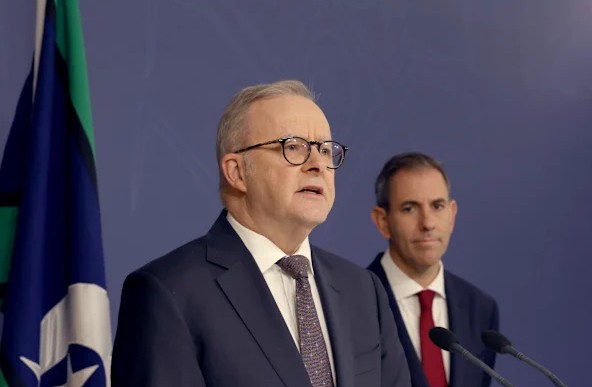
“We are announcing details to allow more small businesses access to the capital gains tax concessions,” Albanese told reporters on Thursday, during a press conference in Sydney. "We’ll increase the turnover threshold for existing small business 50% active access CGT concessions from $2 million to $10 million. This is one of the four concessions that we have said would continue.”
Under the original plan, the current 50% CGT discount would be replaced with a system that taxes gains based on inflation and introduces a 30% minimum tax rate on capital gains. The new carve-outs mean many small businesses will still receive tax concessions when they sell a business or business assets, with the eligibility threshold increasing from $2 million to $10 million in annual turnover. Startups will also receive special concessions, and some inheritance-related trusts will be exempt.
“It is the most widely used of those four CGT concessions used by small businesses in Australia," Albanese said. "A total of 2.7 million existing active small businesses will be eligible for this concession.
"And obviously, we’ll increase the new threshold by five times, bringing into line with the threshold for small business that there (are) in a number of other features of the system,” he continued. “We’re also proposing to introduce a new innovative business tax concession for start-ups.”
Treasurer Jim Chalmers, who was also present at the press conference, said that by raising the eligibility limit for the small‑business concession, roughly 98% of all active businesses would be able to receive the capital‑gains tax relief. But the trade-off is that the carve-outs will also reduce revenue by $475 million over the next four years.
"There are four existing concessions for businesses in the CGT system," Chalmers added. "We're leaving all four in place, but we are making one of them substantially broader and significantly more generous at the same time."
In addition, while the original budget proposal granted the Treasurer broad powers to shape the finer details of the tax rules over time — including defining what qualifies as a “new build” for negative gearing purposes and determining which assets would be eligible for CGT discounts — those powers have now been scaled back. Instead, definitions will be set out in legislation, limiting scope for ministerial discretion.
"We no longer need to give effect to the policy intent," Chalmers said.
The prime minister added that the increase is aimed at making the CGT rules more consistent with how small businesses are defined elsewhere in the tax system.
Currently, businesses with annual turnover of less than $2 million, or net assets under $6 million, are eligible for a range of CGT concessions, including the 50% active asset reduction, when owners sell.
The moves mark notable concessions, following criticism of the proposed changes.
"We welcome the decision to increase the turnover threshold for small businesses to access the 50% CGT discount," said Anja Pannek, chief executive officer of the Mortgage and Finance Association of Australia (MFAA). "This is a positive outcome that will give many small business owners greater confidence to invest, grow, plan for succession and make long term decisions about their future.
"Mortgage and finance brokers work closely with small business owners every day and have seen firsthand the uncertainty these proposed changes created," Pannek continued. "Through our advocacy, submission to the Senate inquiry underway and support of COSBOA's Fair Go campaign, the MFAA consistently highlighted the importance of providing certainty for small businesses planning for the future. Today's announcement delivers that certainty and recognises the vital contribution small businesses make to Australia's economy, communities and employment."
The Council of Small Business Organisations Australia (COSBOA) Chief Executive Officer Skye Cappuccio added that the concessions are "an important and welcome step in the right direction" that will impact hundreds of thousands of small businesses across the country.
"These are often family-owned businesses, manufacturers, professional services firms, transport operators, retailers and trades businesses that employ local people, invest in their communities and continue to face the same challenges as other small businesses," Cappuccio said. "It's encouraging to see recognition that the current thresholds are outdated and that many growing small businesses have been caught between eligibility settings that no longer reflect the realities of running a business in Australia."
Meanwhile, the Housing Industry Association (HIA) has acknowledged that the reforms could reduce investor demand and slow apartment development in the near-term. But the industry body also said that the overall impact on housing construction would be limited rather than severe.
Albanese's camp has previously said it hopes the bill will pass through the upper house by the 2 of July. The Labor party holds a majority in the House of Representatives with 94 seats, but still needs support from the Greens or crossbenchers in the Senate to pass the proposed reforms.