Four Australian cities have been ranked among the world’s most unaffordable places to buy a home, as the share of $1 million-plus dwellings reaches historic highs and affordability continues to deteriorate.
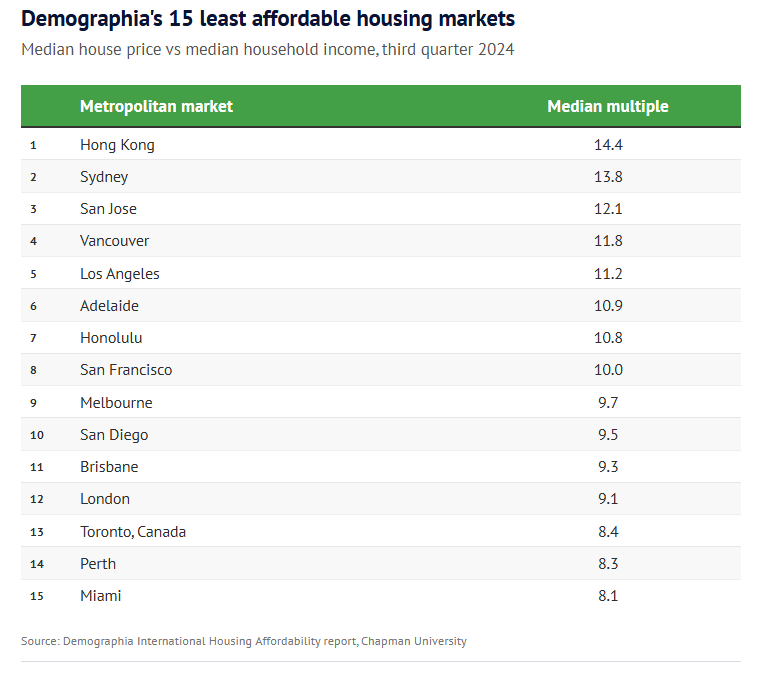
The latest Demographia International Housing Affordability report, published by Chapman University, compared median house prices to median household incomes across 95 major housing markets in eight countries, Domain reported.
Sydney ranked second worst for affordability behind only Hong Kong, while Adelaide (6th), Melbourne (9th) and Brisbane (11th) also made the top tier of “impossibly unaffordable” cities.
Brisbane’s median multiple-rose to 9.3, pushing it into the same bracket as Australia’s largest cities, while Perth received a rating of 8.3—just shy of the “impossibly unaffordable” cut-off.
“Sydney has had the first-, second- or third-least affordable housing of any major market in 16 of the last 17 years,” the report said, noting that Australian cities are now less affordable than “world cities like New York, London, or Chicago.”
Separate data from Cotality (formerly CoreLogic) showed just how deeply affordability has eroded.
More than a third of Australian dwellings—34.4% nationally and 41.6% in the combined capitals—are now worth $1 million or more. In regional areas, that figure has risen from 0.5% a decade ago to 19.4%.
“It matters because it’s not just a shocking number that would buy you so much in any other facet of life,” said Eliza Owen (pictured left), Cotality head of research. “[But] even if you had $1 million, the quality and location of the properties you can access are deteriorating.”
Brisbane recorded the sharpest rise, with million-dollar homes rising from 2.8% to 40.2% in 10 years. In Sydney, the proportion has hit a staggering 64.4%, while Melbourne sits at 30.9%.
AMP chief economist Shane Oliver (pictured right) said the rankings come as no surprise.
“There’s no surprises here that Sydney remains highly expensive. Melbourne is still in there,” Oliver said. “Adelaide has lower average incomes than, say, Melbourne, but it [has] now got average prices which are pushing around or above Melbourne levels.”
Owen noted that wealth inequality is being amplified by the market.
“If you can afford these properties, you’ve got a very high income, you’ve sold another property well, or you have wealth from your family,” she said. “You need to have that big pool of wealth to participate in the market and it’s locking out those that don’t.
“The Sydney housing market is no longer one for savers but one for those with endowments,” she added, pointing to the growing deposit hurdle and rapid price gains.
The Demographia report highlighted policy-driven constraints as core drivers of unaffordability. Urban containment measures, growth boundaries, and restrictive zoning laws were among the main culprits behind price escalation.
“The primary causes of housing unaffordability were ‘urban containment’ measures… and restrictive land use policies,” it said.
With affordability in capital cities at crisis levels, many Australians are shifting their search to satellite and regional cities in search of cheaper alternatives, particularly post-pandemic.
PropTrack has highlighted strong growth in traditionally affordable satellite cities such as Geelong, Bendigo, Newcastle and Toowoomba, where buyers are still within commuting distance but face lower entry prices.
Regional electorates such as Barker in South Australia, Mallee in Victoria, and Hinkler in Queensland are also being spotlighted for affordability, with median house values under $450,000 and price-to-income ratios below the national average.
For buyers looking to upgrade from a unit to a house, four capital city suburbs were recently identified as offering better-than-average value: Davoren Park (Adelaide), Camillo (Perth), Tregear (Sydney), and Deception Bay (Brisbane).
Australia's housing affordability crisis is now more entrenched than ever, with record-high home values, worsening income-to-price ratios, and a growing concentration of million-dollar markets.
While regional and outer-ring suburbs still offer relative value, the national trajectory remains clear: without policy reform and a substantial lift in housing supply, affordability will only continue to worsen.