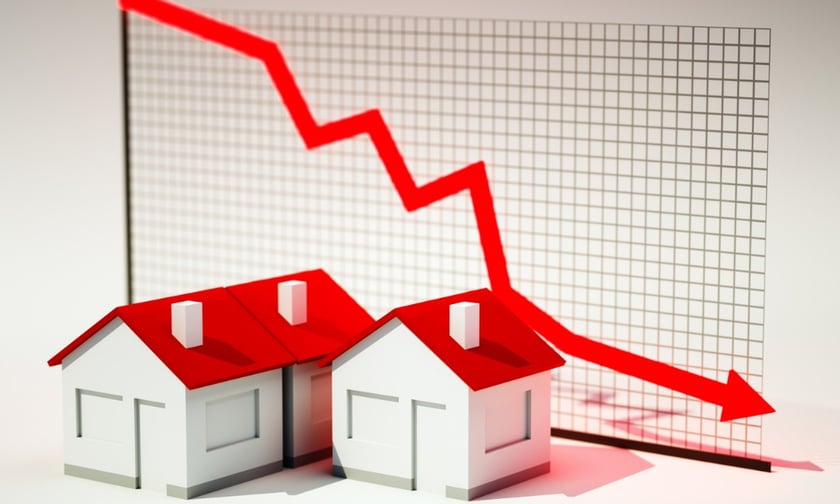
The most recent auction results are the latest flashing signs that Australia's housing market is cooling.
According to research firm Cotality, the preliminary auction clearance rate fell to 50% in July, down from 54.8% the previous week. Clearance rates had already dipped below 50% in late June and early July, a level widely seen as indicative of a buyer's market.
"Ray White determines a buyer's market when clearance rates drop below 65%," Joey Delis, Adelaide-based broker at Loan Market, told Australian Broker. "So to me it does feel like a buyer's market."
Nerida Conisbee, chief economist at Ray White, agreed, "it's definitely a buyers market," citing softening prices and fewer buyers in the market.
"We've seen a drop off in the number of people going to auction, so that will probably keep the number fairly stable," she continued. "We've still got a lot of uncertainty around what's happening with inflation and consumer confidence is low. And then, of course, the budget has added another layer of uncertainty."
Hobart-based economist Saul Eslake agreed that the lower auction levels "will go on for some time, maybe a year. Partly because there's a chance the Reserve Bank will raise interest rates again, possibly in August. And second, because the tax changes in the budget will have a lasting impact on the demand for established properties, which is what gets auctioned."
But what that means for brokers and buyers, however, is less straightforward.
"The issue, though, is that when the market does switch and it does become a buyer's market, it does take some time for buyers to actually come back in," Conisbee explained. "Typically, what we find is that as prices are falling, there remains very little buyer activity. But when prices start to recover a little bit, that's when we start to see people pile back in. The issue is that people don't like buying in a falling market. And the reason being is that they typically think they can get a better price if they wait a bit longer. It's just human nature because most people don't feel they need to rush the market if prices are falling; it's not an urgent market. And as a result, people can take their time and transact.
"So for now, even though it is a good time for buyers, they will likely remain very, very cautious until we start to see some more positive signs in the market," the economist continued. "But when markets start to recover, they recover very, very quickly and prices shoot up and we will start to see more buyer activity. But the real trigger will probably be something like a rate cut, which isn't going to happen soon. But I think that will probably be the next thing that leads to a big surge in activity."
For the moment, however, buyers are contending with three interest rate hikes from the Reserve Bank of Australia (RBA) in 2026 alone, persistent inflationary pressures and rising costs of living on top of budget changes that have caused lingering uncertainty in the markets.
Brokers, meanwhile, are seeing mixed conditions. Some say activity remains subdued as buyers wait for greater clarity. Others say the market slowed briefly after the budget but has begun to stabilise now that the policy changes are settled and uncertainty has eased.
Delis said the biggest volume of applications in his business is coming from existing homeowners looking to scale upwards.
"The most action is coming from upgraders at the moment," he said. "People who own a home and are looking to upsize into a larger home. They're actually probably the most frequent buyers at the moment because even if they sell their house and they don't get as much as what they expect it's worth, they're probably also buying at a time when it's not as expensive. So they're in a position where they get a little bit less for their house, but they're probably buying at a cheaper rate too."
The broker added that the current environment is also working in favor of turning pre-approvals into settled loans.
"Pre-approvals are probably more likely to convert," Delis explained. "There was a period where we got people pre-approved and they just couldn't find a house to buy. But slowly, as the supply starts to increase online and vendors that need to sell start to realize they need to adjust their price expectation, it's probably more likely that some of these pre-approvals will convert.
"And we've actually seen a lot of banks who never fully assessed pre-approvals actually come out in the last few weeks and say they're willing to fully assess pre-approvals now because their volumes have dropped," he explained. "They've got time to actually work on pre-approval applications now. But when they were busy, they just sort of didn't want to deal with them."
In addition, first-time homebuyers are "holding steady," according to Delis.
"Nothing's really changed what they're doing," the broker said. "I think people just feel that if they want to buy an established home, now's the time to do it because there's less competition from investors. If I was trying to buy, this is exactly the type of market that I want. I would want less competition, and I would be reaching out to my broker to get started, just in case an opportunity pops up."