
NAB’s June Monthly Business Survey shows signs of stabilisation across the Australian business sector, with business conditions rising 8 points to +9 and confidence lifting three points to +5.
This marks the first trend increase in conditions this year and the third consecutive monthly rise in confidence, now at its highest level in over 12 months.
“The June NAB Business Survey suggests that business conditions are stabilising, if not starting to turn around after a disappointing start to the year,” said NAB senior economist Tony Kelly (pictured left) and NAB head of Australian economics Gareth Spence (pictured right).
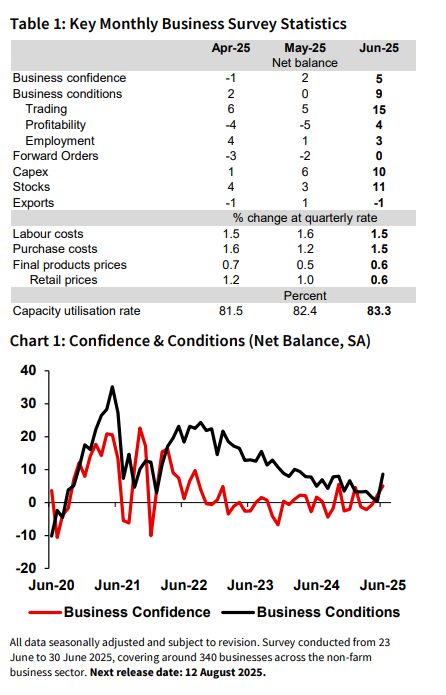
The rise in conditions was driven by a broad-based lift in sub-indices. Trading conditions rose 10 points to +15, profitability jumped nine points to +4, and employment rose two points to +3. Forward orders increased to zero, the best result since September 2023, and capital expenditure rose to +10.
“Capacity utilisation rose for the second consecutive month and is again clearly above its long-run average,” Kelly and Spence said.
Conditions improved across most industries, with strong gains in manufacturing and retail. However, wholesale and transport remained flat. In trend terms, the recreation & personal, and finance, property & business sectors performed best, while manufacturing and retail were weakest.
State-level results were similarly uneven. Queensland and Tasmania posted large improvements in conditions, while South Australia and Western Australia recorded declines.
“In trend terms, conditions and confidence are strongest in Qld and Tasmania, but weakest in SA, Vic and WA,” the NAB economists said.
Cost indicators remained high, with purchase costs rising to 1.5% and labour costs easing slightly to 1.5%. Product prices grew 0.6%, while retail price growth slowed to 0.6% – its lowest since early 2023.
“Cost growth still remains elevated, but price growth has eased suggesting ongoing profitability pressures,” Kelly and Spence said.
“Conditions are stable at around average levels but are not necessarily improving,” Coombs said. “Capacity constraints remain a challenge even with lacklustre growth. Meanwhile, confidence is volatile – a likely reflection of the increasingly uncertain world businesses are faced with.”
He added that while signs of stabilisation are emerging, a broader consumer rebound is needed to support meaningful improvement.
“Still elevated capacity utilisation goes a long way in explaining relatively stubborn growth in input prices for businesses,” Coombs said. “Even with soft economic growth, the survey suggests capacity has not yet caught up to demand.”