
Australian home values surged to a new record in May, rising 0.39% nationally, according to the latest PropTrack Home Price Index.
This marks the fifth consecutive month of growth, with home prices now 4.12% higher than a year ago.
The price surge comes despite falling homeowner sentiment, which dropped 4.8 points to 85.7 amid recent rate moves, ANZ-Roy Morgan data showed.
“National home prices rose 0.39% in May, marking the fifth consecutive month of growth and a new record high for Australian home values. With interest rates falling, price momentum has increased and broadened, with all capitals seeing prices lift in May,” said Eleanor Creagh (pictured), REA Group senior economist.
Capital city markets led the charge, growing 0.45% in May. While every capital city recorded monthly gains, Melbourne posted the strongest rise (+0.79%), extending its recovery after a sluggish period. However, Melbourne’s home values remain 2.85% below their peak, PropTrack data showed.
“Price growth across the capitals is starting to converge. Melbourne, which previously lagged the other capitals, is now seeing home price growth pick up,” Creagh said.
“Cities such as Perth and Brisbane are now seeing growth moderate after strong outperformance. The growth seen in all capital cities is underpinned by improved buyer sentiment and renewed confidence following interest rate cuts.”
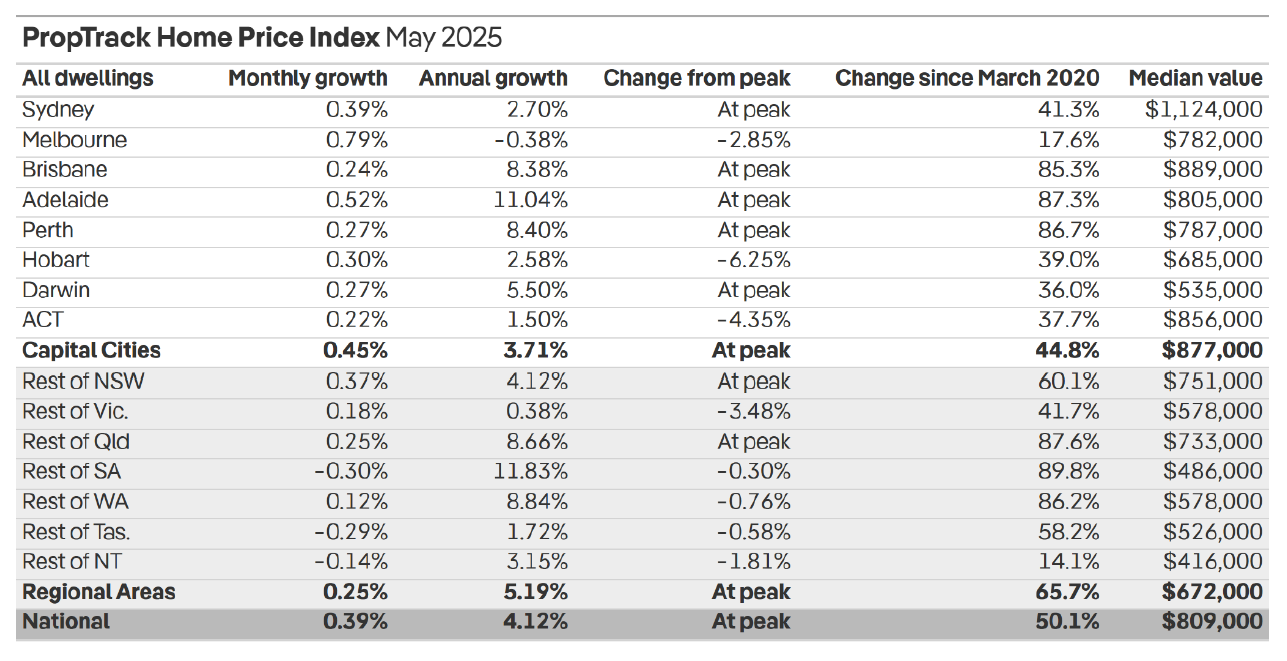
Despite Melbourne’s strong monthly showing, Perth’s median home value ($787,000) has now overtaken Melbourne’s ($782,000) for the first time in ten years. The milestone reflects Perth’s consistent outperformance in recent years, driven by affordability and resilient demand.
Adelaide led the nation in annual growth, with home prices up 11.04%, followed by Perth (+8.4%) and Brisbane (+8.38%). Although these cities remain annual leaders, momentum is now picking up in slower-growth markets such as Melbourne, Canberra and Hobart.
Regional home prices grew 0.25% in May and are now 5.19% higher year-on-year, outstripping the 3.71% growth in combined capital city prices. Over the past five years, regional values have skyrocketed 65%, underscoring their sustained popularity.
CoreLogic’s Home Value Index also reported a 0.5% monthly rise in May, with all capitals gaining ground. The national index was 1.7% higher over the first five months of the year, though annual growth slowed to 3.3% – the weakest since August 2023. Melbourne and Canberra were the only capitals to record annual declines.
CoreLogic also noted that value growth remains strongest in lower price segments, and capital city price trends are converging more closely than at any time since March 2021.
The recent shift in interest rates is accelerating market momentum.
“Lower interest rates have lifted borrowing capacities and boosted buyer demand. And with further price increases and rate cuts expected, prospective buyers are moving off the sidelines and accelerating their purchasing decisions,” Creagh said.
She added that structural market issues would likely support further gains.
“Looking ahead, while stretched affordability will remain a constraint, a chronic lack of new housing supply, population growth, and targeted buyer incentives are expected to keep upward pressure on prices,” she said.
“In combination with interest rates continuing to move lower, these factors are likely to drive further price growth throughout the remainder of 2025.”
With improved confidence, easing rates, and tight supply, analysts expect Australia’s housing market to continue strengthening throughout 2025 – though affordability challenges may limit the pace. For now, all signs point to further price gains on the horizon.
To access the PropTrack report and for more insights, follow this link.