
As Australia grapples with its ambitious home-building target, new ABS data revealed that more than 20,000 dwellings were approved for demolition in the year to March, realestate.com.au reported.
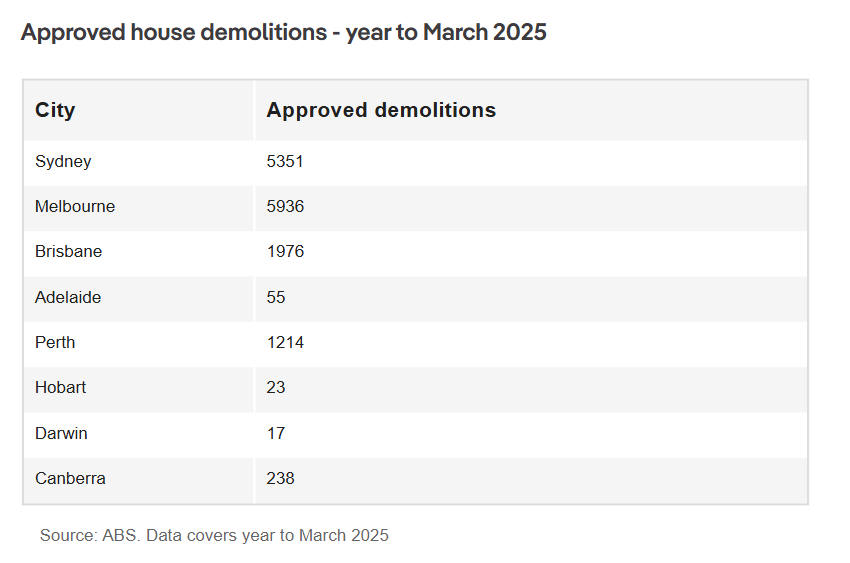
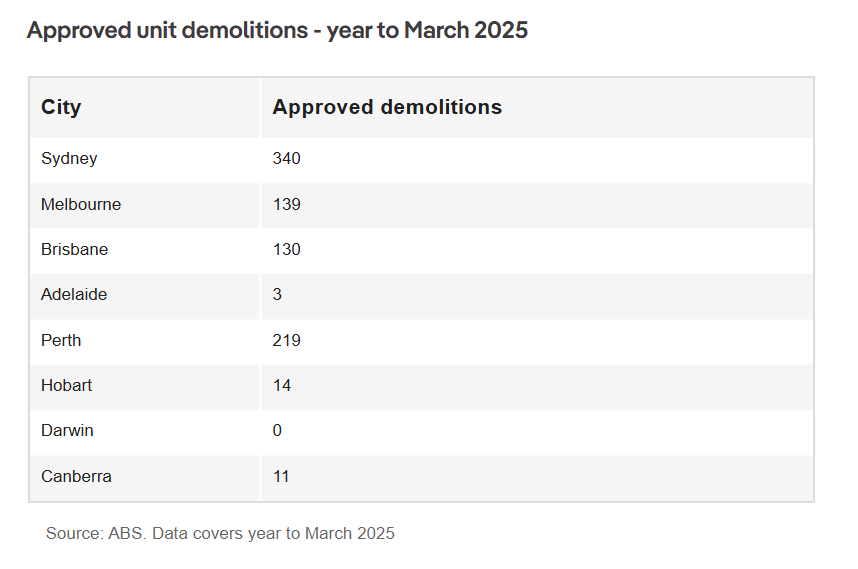
Of these, 18,864 were houses, while 1146 were units.
Melbourne leads the country with 6075 properties set to face the wrecking ball. Sydney follows with 5351 house demolitions and 340 units. Brisbane recorded 2106 demolitions, and Perth 1433.
In contrast, demolitions in the smaller capitals were limited: Canberra saw 249 approvals, Adelaide 58, Hobart 37, and Darwin just 17.
Beyond the major cities, regional NSW recorded the highest number of demolitions at 1759, followed by regional Queensland (1152) and regional Victoria (1042). Many of these properties have already been cleared, as the data covers a full 12-month period.
Despite these figures, demolitions make up only a fraction of overall building activity. More than 181,000 new homes were approved for construction over the same period, providing a significant boost to Australia’s constrained housing supply.
However, with just four years left to deliver on the federal government’s 1.2 million new homes target by 2029, current approval levels remain well short of what's required.
The Urban Development Institute of Australia (UDIA) forecasts that Australia will fall nearly 400,000 homes short of its 1.2 million housing target by 2029, with a projected shortfall of 393,000 dwellings across capital cities.
Anne Flaherty (pictured), REA Group senior economist, said knockdowns are largely driven by plans to replace older homes with new builds.
“Demolitions happen because new homes are being built,” Flaherty said. “We do see more homes approved than are demolished.”
But she added that to understand how much net housing stock is increasing, the demolition effect needs to be considered.
“But if we look at how many homes we need to build, we need to take into account the fact that a percentage of the new homes that are going to be built are going to result in demolitions,” Flaherty said.
Many of these approvals likely involve the replacement of one home with two or more dwellings – such as duplexes, townhouses, or apartment developments.
“Hopefully for every home that’s demolished, it can result in more than one home that’s replacing it,” Flaherty said.
The densification of existing suburbs – particularly those near transport – has been flagged as a key strategy to address the housing crisis.
Policies like the NSW Transport Oriented Development Program are expected to drive more apartment construction and increase demolition activity along key corridors.
However, this push has been tempered by economic headwinds. Rising construction costs and high interest rates have made many projects financially unviable, contributing to a decline in demolition activity compared to earlier peaks.
Demolition approvals hit their high in the year to June 2022—when rates were at record lows and the government’s HomeBuilder scheme had supercharged demand, realestate.com.au reported.
Flaherty noted that current market conditions are influencing the types of housing being delivered.
“It’s very expensive to build new, which means the kinds of homes being built are the ones most likely to generate sufficient profits for developers,” she said.
“House and land packages in outer areas are broadly the most feasible new housing product at the moment.”
By contrast, apartment and townhouse projects face higher costs per square metre, limiting new unit supply.
“When it comes to building apartments and townhouses, the cost per square metre is much higher than a house, so we’re not seeing the same degree of new unit development that we have seen previously,” Flaherty said.
Much of the current apartment development is targeting premium buyers.
“A lot of the unit stock being developed at the moment is focused at the higher end of the market,” Flaherty said, “which was more profitable compared with more affordable homes.”
Looking ahead, Flaherty said any uptick in housing approvals will depend on interest rates falling and house prices rising in key markets.
“As interest rates come down, that's going to help to make more projects feasible,” she said.
“Dwelling approvals are really picking up in states where price growth has been stronger, and once we start to see home price growth pick up in Victoria and NSW, we would expect to start to see an increase in dwelling approvals.”