
Mortgage stress among Australian home loan holders could climb even further if the Reserve Bank raises rates again in the coming months, according to new modelling from Roy Morgan, which already shows stress rising for a fifth consecutive month.
Roy Morgan modelled two scenarios based on potential RBA moves in August and September.
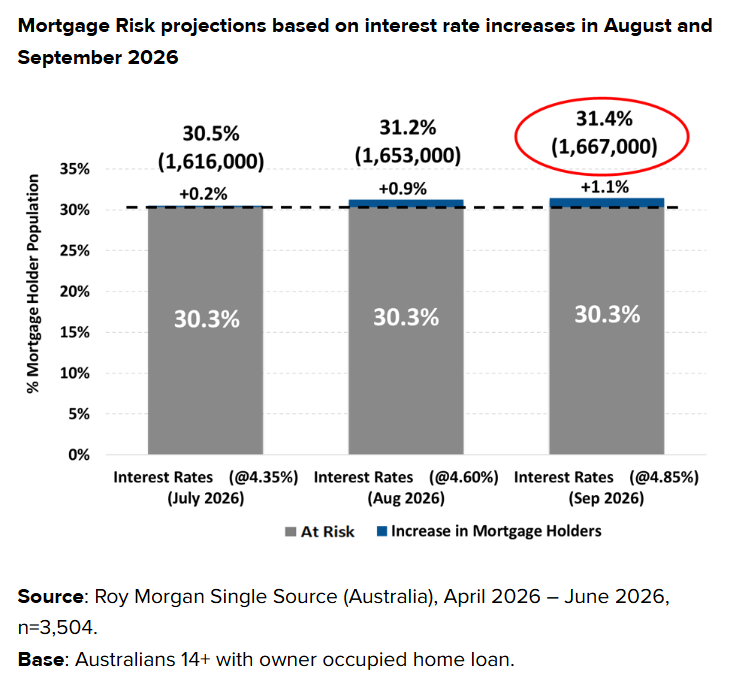
A further 0.25 percentage point rise in August, to 4.6%, would push the at-risk share to 31.2%, equivalent to 1,653,000 mortgage holders. A second increase in September, to 4.85%, would see that figure climb to 31.4%, or 1,667,000 people, a level Roy Morgan CEO Michele Levine (pictured) noted would take rates to their highest point in nearly 20 years, since December 2008.
Alongside that risk, 1,096,000 mortgage holders, or 20.7%, are already considered "extremely at risk," well above the two-decade average of 16.4%.
That modelling builds on an already-rising trend: 30.3% of mortgage holders were "at risk" of stress in the three months to June, up 1.3 percentage points on May and equivalent to 1,606,000 people, an increase of 68,000 on the previous month and 115,000 higher than a year earlier.
Roy Morgan attributes the rise to the Reserve Bank's decision to lift the cash rate by 0.25 percentage points in May, to 4.35%, following earlier increases in February and March.
Levine noted that leaving rates unchanged at the RBA's mid-June meeting provided a welcome reprieve for mortgage holders, even as she flagged that stress is now at its highest level since June 2024, which was also 30.3%, just before the modified Stage 3 tax cuts boosted household incomes.
Despite the rate-driven rise in stress, Levine pointed to employment, income, and inflation as the factors that matter most beyond the cash rate itself.
"The largest impact on whether a borrower falls into the 'at risk' category is related to household income, which is directly related to employment," she said.
Roy Morgan's latest estimates show the workforce has begun contracting after several years of strong job creation, a shift Levine said warrants close attention alongside the rate outlook.
On inflation, she pointed to a potential silver lining: the ABS Consumer Price Index eased to 4% in the 12 months to May, down 0.6 percentage points from 4.6% in March, though she cautioned that renewed tensions in the Middle East could put that improvement at risk.
Rising mortgage stress isn't translating into a refinancing rush; if anything, the opposite. Equifax's June data shows Australian mortgage demand fell 14% year-on-year, with no state or age group recording positive growth, and refinancing activity falling just as sharply.
Get the hottest and freshest property and mortgage news delivered right into your inbox. Subscribe now to our FREE daily newsletter.