Australia’s economic recovery faces major headwinds, not just from inflation or interest rates, but from a deeper and more structural problem: widespread distrust.
According to Roy Morgan CEO Michele Levine (pictured), “Australia has become a fragile nation,” with rising distrust in institutions, weakening consumer sentiment, and signs of financial strain undermining growth at the start of the 2026 fiscal year.
Speaking during Roy Morgan’s Fiscal Year 2026 Insights Webinar, Levine and Nine Network national finance editor Chris Kohler unpacked the drivers of Australia’s economic unease.
The pandemic marked a turning point for public trust, Levine said, pushing the economy into net distrust territory, where it has remained ever since.

“COVID exposed and amplified existing weaknesses in institutional trust, permanently altering how Australians judge institutions, brands, and leaders,” she said.
“A distrusting public becomes inherently risk-averse – spending less, saving more, and doubting every institution – effectively stalling economic momentum.”
Roy Morgan data highlighted the extent of the malaise.
The ANZ-Roy Morgan Weekly Consumer Confidence index has remained below 100 for over three years – the longest and deepest stretch this century. In May 2025, it sat at just 87.9, a figure far from neutral territory.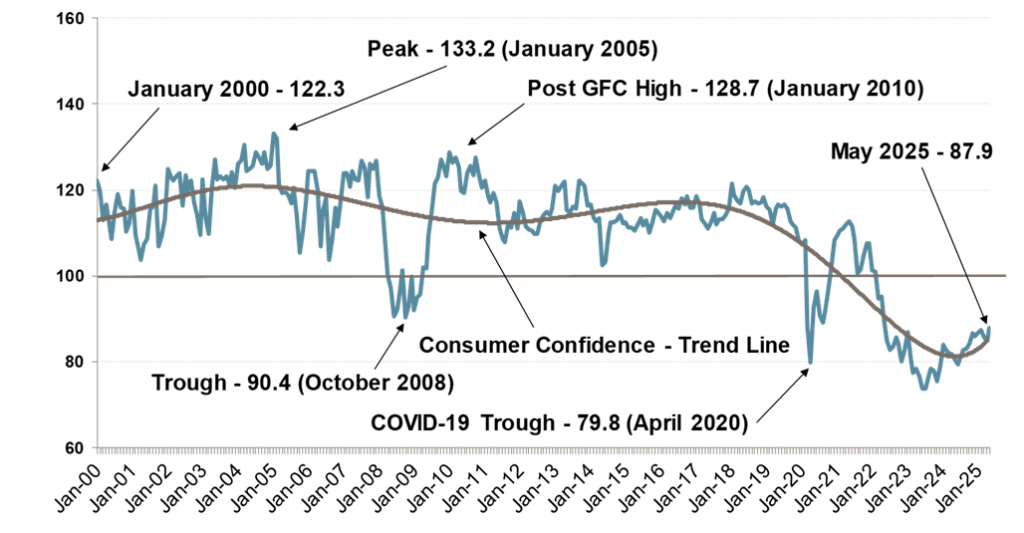
“Low confidence isn’t just a mood swing; it feeds a self-reinforcing cycle in which households pull back on discretionary spending, businesses delay new investments or hiring, and government revenues come under pressure,” Roy Morgan said.
Even as inflation eases and interest rates fall, distrust continues to act as a “hidden brake” on recovery. Australians remain wary of banks, governments, and large institutions, slowing down the consumer-led momentum often critical for sustained growth.
Levine asked: “So Chris, despite low consumer confidence, interest rates are falling, retail spending’s improving, business confidence is growing, inflation appears to be under control, so what’s it going to take to get the economy firing again?”
Kohler responded with cautious optimism: “They’re all really nice things aren’t they… I think to really let all those factors you mention soak in to all of the different parts of the economy you just have to wait a little while.
“There’ll be more rate cuts. Absolutely… In another few months, or maybe towards Christmas, you might start to see that general sense of wellbeing improve.”
The Reserve Bank (RBA) is widely expected to cut the cash rate by 25 basis points to 3.6% in August, following a surprise hold at 3.85% in July. A Reuters poll of 30 economists found unanimous support for an August cut, with most also forecasting another cut by Q4.
Further signs of economic vulnerability come from the rapid rise in buy-now-pay-later (BNPL) usage.
New Roy Morgan figures show that 24.5% of Australian adults used BNPL in the past year, while 15.9% used it in the past month, indicating growing dependence.
“While it can feel like a convenient short-term fix, rising BNPL adoption often masks deeper financial stress,” it said, pointing to higher unsecured debt, multiple accounts with different providers, and reduced household resilience.
The trend is especially worrying as BNPL expands into everyday essentials like groceries and utility bills.
Kohler flagged the broader economic impact: “Consumer debt products have just become so available, you can be approved instantaneously… One of the problems I think about buy-now-pay-later that doesn’t get talked about that much is the merchant fees on businesses – they’re about 4% – which is significantly higher than it is for a credit card or debit card purchase.
“So, the expansion and growth in BNPL is costing money to the economy in a few different ways… These small businesses are having to swallow (this cost) and pass it on. The BNPL services don’t really want the businesses to pass these costs on though.”
The fiscal year has begun with some signs of economic resilience—including falling inflation, steady job markets, and improving business conditions—but underlying distrust and debt stress continue to dampen momentum.
“Even as inflation eases… the brakes on recovery aren’t released. While that continues, the broader economy will struggle to regain real momentum,” Levine said.