
Australia’s housing finance market lost momentum in the first quarter of 2025, with new loan approvals slipping after strong gains in late 2024.
While the February rate cut offered some support, the overall housing upturn appears to be cooling, particularly in construction-related finance.
This softening in lending comes despite a notable rebound in buyer sentiment.
According to Westpac’s Matthew Hassan (pictured), the value of new dwelling finance approvals (excluding refinancing) fell 1.6% quarter-on-quarter, in line with the bank’s forecast. The number of loans dropped more sharply, down 3.5%, highlighting that average loan sizes are still rising.
“Approvals have been essentially flat over the last two quarters after a 14.6% surge over Q2 and Q3 last year,” Hassan said. “Annual growth slowed to 14.2%yr from a peak of 24.6%yr in Q3 last year and is likely to slow to a single-digit pace in Q2.”
He also pointed out that rising average loan sizes contributed 8.2 percentage points to annual growth in the value of loans.
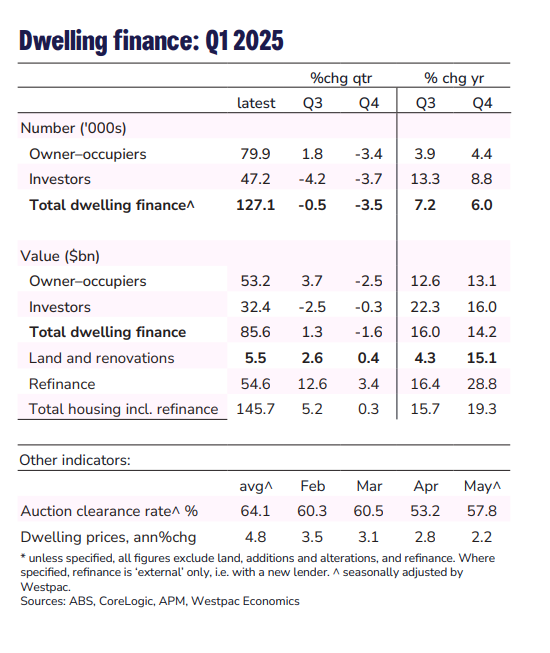
The downturn was led by owner-occupier lending, with the number of loans down 3.4% and their value down 2.5%. Loans linked to new construction saw a notable 4.5% fall, driven by a 7.8% drop in finance for newly built homes, including off-the-plan apartments.
State-level figures showed mixed results for owner-occupier lending:
“Noting that all quarterly moves were milder than the national decline, which can be a sign that there are seasonal adjustment issues,” Hassan said.
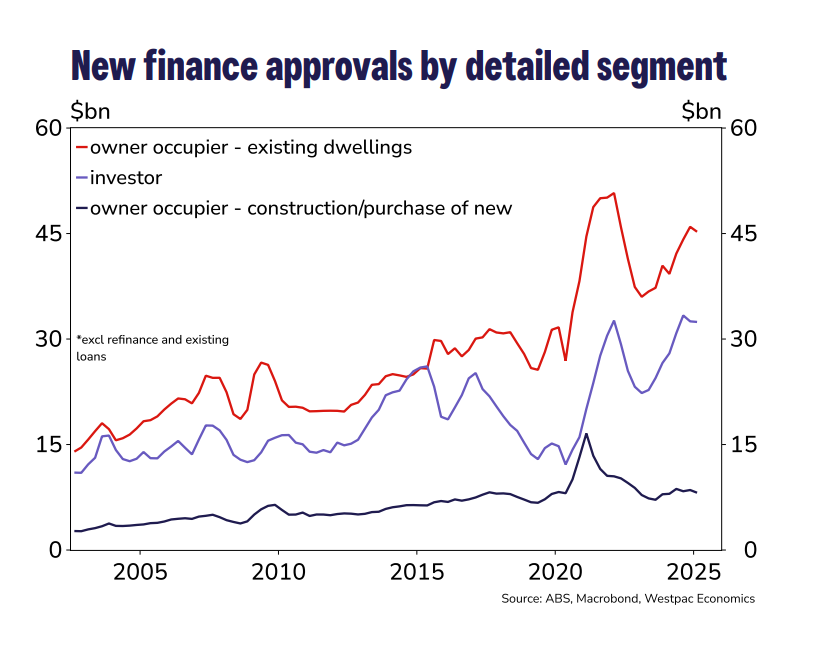
Investor loans fared slightly better, recording only a 0.3% quarterly drop, following a 2.5% fall in Q4 2024. However, weakness was evident in NSW and WA, with annual growth still above 10% in most regions except the ACT.
According to the Westpac report, while RBA’s February interest rate cut provided some lift—particularly in Sydney and Melbourne, where demand had softened—the national picture remains tepid.
“Overall, the picture in early 2025 is of a housing upturn that has lost considerable momentum,” Hassan said.
The trend is especially visible in formerly high-growth capitals like Brisbane, Adelaide and Perth, where price growth has moderated and turnover remains subdued.
“The weakness in construction-related loans is also of note, suggesting the lift in dwelling approvals in recent months is likely to fade,” Hassan said.
“All up, the picture is of a housing upturn that has lost much of its momentum and a sector that may continue to lack direction near term.”