
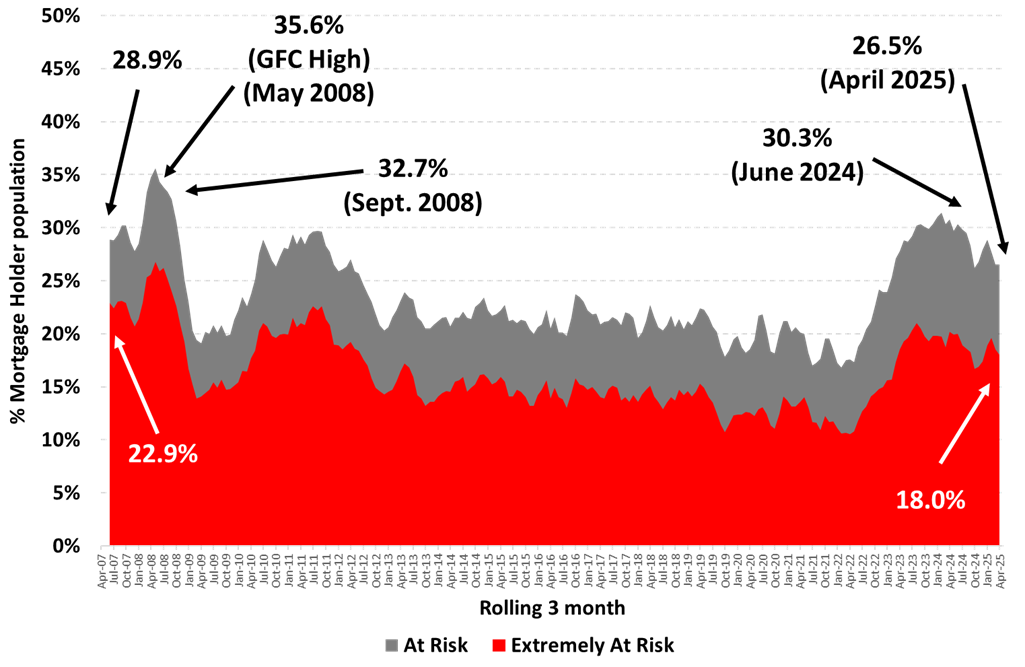
New Roy Morgan research has revealed 26.5% of mortgage holders were “at risk” of mortgage stress in the three months to April, unchanged from March.
The figures reflect conditions prior to the Reserve Bank’s 0.25% interest rate cut last week, which economists say is expected to reduce stress in the coming months.
“The latest Roy Morgan data shows 1,429,000 Australians were ‘at risk’ of mortgage stress in April 2025 equivalent to 26.5% of mortgage holders ‘At Risk’ (unchanged from March 2025),” said Roy Morgan CEO Michele Levine (pictured).
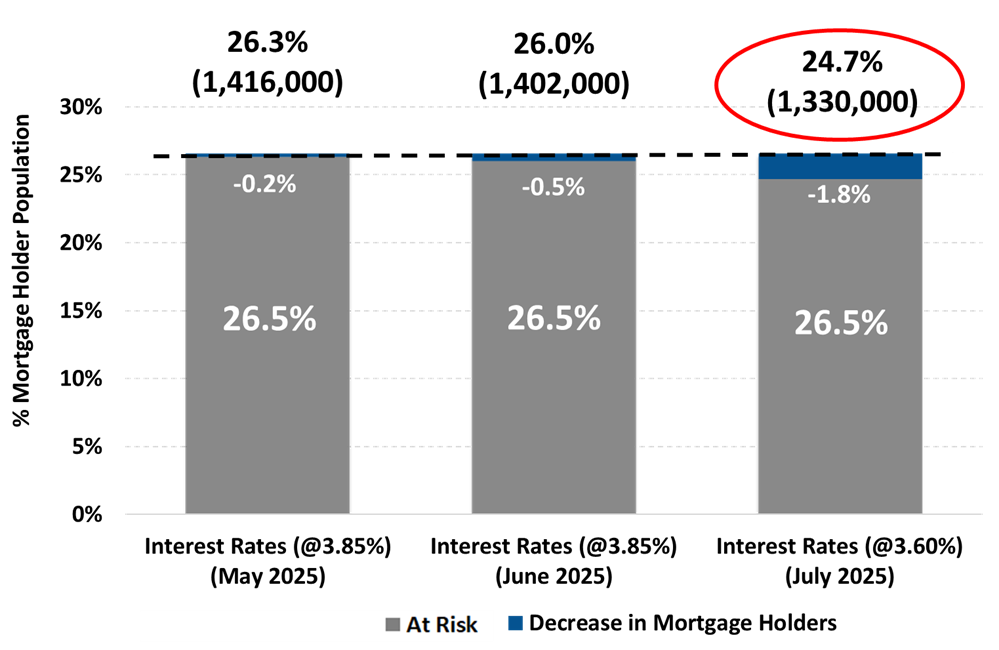
The official cash rate is now 3.85%, the lowest since May 2023, following two 0.25% cuts in February and May. According to Roy Morgan, this latest cut is forecast to bring down the percentage of “at risk” borrowers to 26.3% in May and 26% in June—a drop of 27,000 households.
“Roy Morgan has modelled last week’s interest rate cut on the level of mortgage stress for both May and June, and this latest cut is set to reduce those Australians ‘at risk’ of mortgage stress to 26% of mortgage holders (1,402,000) by June,” Levine said.
Looking ahead, a potential third rate cut in July – bringing the cash rate to 3.6% –could push the number of “at risk” mortgage holders down to 24.7%, or 1.33 million Australians. That would be the lowest rate of mortgage stress since January 2023.
“The RBA next meets to decide on interest rates in early July, and an additional standard interest rate cut of 0.25% to 3.6% would result in a significant reduction in mortgage stress – down to 24.7% of mortgage holders,” Levine said.
Some industry experts, however, questioned how much relief interest rate cuts will actually provide.
“On a $1.4 million loan, a 6.75% loan rate dropping to 6.5% will only save the mortgage holder around $107 per fortnight,” the Scotts said. “That’s not likely to be enough to give most mortgage holders a meaningful reprieve.”
Despite the easing trend, mortgage stress remains well above pre-hike levels. Since the Reserve Bank began raising rates in May 2022, the number of Australians “at risk” has grown by 622,000.
“Despite the RBA cutting interest rates this year, mortgage stress is still significantly higher than before the RBA began raising interest rates in May 2022,” Levine said. “There are over 600,000 more mortgage holders ‘at risk’ of mortgage stress today than there were in May 2022.”
RBA’s decision to lower rates has been supported by falling inflation, with annual CPI at 2.4% in March, marking the eighth straight month within the RBA’s 2-3% target band.
“This is the eighth straight month the official inflation estimates have been within the RBA’s preferred target range of 2-3% and is the driving factor behind the RBA’s decision to lower interest rates,” Levine said.
While lower interest rates help, employment remains the most critical factor influencing mortgage stress.
Roy Morgan estimates that over one in five workers (20.4%) are either unemployed or under-employed, despite Australia adding more than 1 million jobs since April 2022.
“The good news is... the employment market has been strong over the last three years... and this has provided support to household incomes which have helped to moderate levels of mortgage stress over the last year,” Levine said.