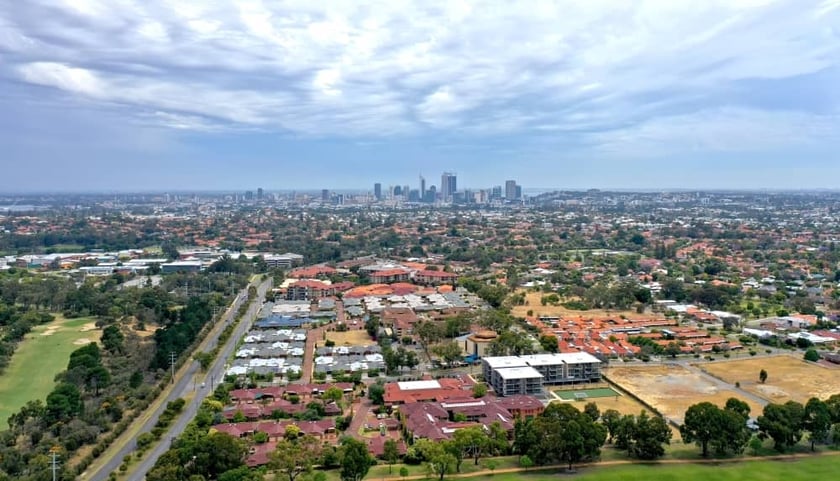
Perth's housing market may have reached its peak.
After years of double-digit growth that transformed Western Australia's capital into one of Australia's hottest housing markets, mortgage brokers say the city may have finally reached its ceiling.
"There's definitely been a change in sentiment and there's a real fear that the market has reached its peak," Bianca Patterson, mortgage broker and finance specialist at Calculated Lending in Inglewood, Western Australia, a suburb of Perth, told Australian Broker.
The signs have been building for months: homes that once sold in days are now sitting for longer. For sale house listings climbed to more than 5,000 in May, according to the Real Estate Institute of Western Australia (REIWA). That's the first time listings have been that high since late 2024.
Meanwhile, the growth in Perth's home values by month were up 2.4% in November 2025, but have since slowed to 1.5% by May 2026, according to research firm Cotality. Commonwealth Bank of Australia (CBA) data revealed that Queensland's housing market has surpassed Perth as the strongest performing market in the June quarter. The frenzy that defined Perth's market for the better part of three years has given way to something quieter.
"Since the budget and since the three consecutive rate rises, the market has definitely slowed here in WA," Patterson explained. "It's really the first pause or correction our market has seen in about six years.
"It might also be that it's just a period of a lot less growth than we've seen," the broker added. "Our market was moving at a very rapid pace and now it's just moving at more of a normal pace. We are seeing more properties on the market as well. So it's just more of a balanced market here."
There are a number of factors behind the slowdown, with Patterson pointing to changes in the broader economy and the fallout from Perth’s once-booming mining industry as potential drivers.
"We're very linked to mining and ore in WA," she explained. "And there's a lot of restructuring happening in mining at the moment; there's a lot of redundancies happening. So there are a lot of experienced property investors and just people who have owned property for two decades who went through the last mining boom and then bust."
Claire Viskovich, founder, director and mortgage broker at Perth-based Beez Neez Finance, said much of Perth's growth came from COVID times, and subsequent lifestyle changes.
"More people could work from home and it didn't seem like as much of a thing that you had to be located in a particular city," she explained. "And because we dealt with COVID so well, it seemed like more people wanted to live here as well. And then you saw the outer suburbs go up very quickly because of that. And now I'd say that the market has stabilized more than anything."
Still, affordability remains a major driver behind the slowdown. Perth's median house price rose from $750,000 to $850,000 in 2025 alone. That's a 13.3% jump in a single year, according to REIWA. For many buyers, that ceiling is now simply out of reach. Borrowing capacity has not kept pace with price growth, and the pool of buyers who can stretch to meet the market is shrinking.
Amol Agrawal, founder and finance broker at Juice Finance in Bunbury, Western Australia, said the unaffordability crunch is becoming increasingly evident in declining buyer turnout at open homes.
"Where there used to be 15 to 20 groups of people who would come to an open home, and someone from the East Coast would pretty much always buy on site, now I've been told by agents and clients that maybe two or three groups come through to the open home. And if there's an offer, it's just one," he explained.
Meanwhile, a range of economic pressures are impacting the market, including the new federal budget, higher interest rates (and the prospect of more), persistent inflation, rising living costs, growing unemployment and continued global volatility. All of this is contributing to the slowdown.
"Before, when there was uncertainty, it was driving up prices. Now, it's driving prices down." Agrawal said. "For owner-occupiers, the fear is that people believe the market will continue to go down, especially with all the news media promoting property prices will go down. For sellers, the fear is of missing out on a good price if they're not selling it right now."