Australia’s housing blocks are getting smaller — and buyers are changing their expectations accordingly, according to Megan Lieu (pictured), economic analyst at REA Group.
“The land size of sold properties is declining, and buyer search patterns are aligning with this trend reflecting changes in economic, demographic, and planning factors over the past decade,” Lieu said.
New PropTrack data shows the median land size of houses sold nationwide has been trending downward since 2015. In that year, the typical house sat on a 670sqm block, falling steadily to 645sqm in the past year, the smallest in a decade.

This shift comes as Australia’s property market continues to show resilience, with prices rising even as land parcels get smaller. National home prices rose 0.5% in September — the ninth straight month of gains — pushing values to a record high, according to the latest REA Group PropTrack Home Price Index. Home values are now 6.2% higher over the year, adding about $54,100 to the median home.
Lieu said the shift to smaller land parcels reflects a mix of population growth, planning reform, and affordability pressures.
Since 2015, Australia’s population has increased by 15% and is projected to grow by another 16% over the next decade, according to the Australian Bureau of Statistics.
“The increase in population naturally increases demand for housing, especially in metro areas where the majority of Australians live,” Lieu said. “With land supply constrained by geographic boundaries, planning and zoning restrictions, land and ultimately housing costs tend to rise.”
To keep prices within reach, developers have reduced lot sizes, while governments have implemented zoning reforms encouraging infill development near transport and amenities.
“These changes have contributed to a faster decline in house block sizes in capital cities compared with regional areas,” Lieu said.
The decline in block sizes has produced an interesting parallel in buyer behaviour, as Australians adjust their property search preferences to match market realities.

“In 2020, the most searched property type was a house with four bedrooms and two bathrooms on a 600sqm block,” Lieu said. “From 2021 onwards, buyer search preferences have shifted with the most popular land size and configuration consistently being a 500sqm house with four bedrooms, two bathrooms.”
By 2024 and 2025, interest in 400sqm four-bedroom homes surged, overtaking searches for larger 600sqm lots.
“With fewer new houses being built on large blocks and the supply of existing ones remaining largely unchanged, the cost of larger houses tends to be higher,” Lieu said. “In the face of affordability pressures, buyers have had to turn to houses on smaller blocks, leading to increased demand for these properties.”
While land sizes have declined, house floor areas have remained stable over the past decade.
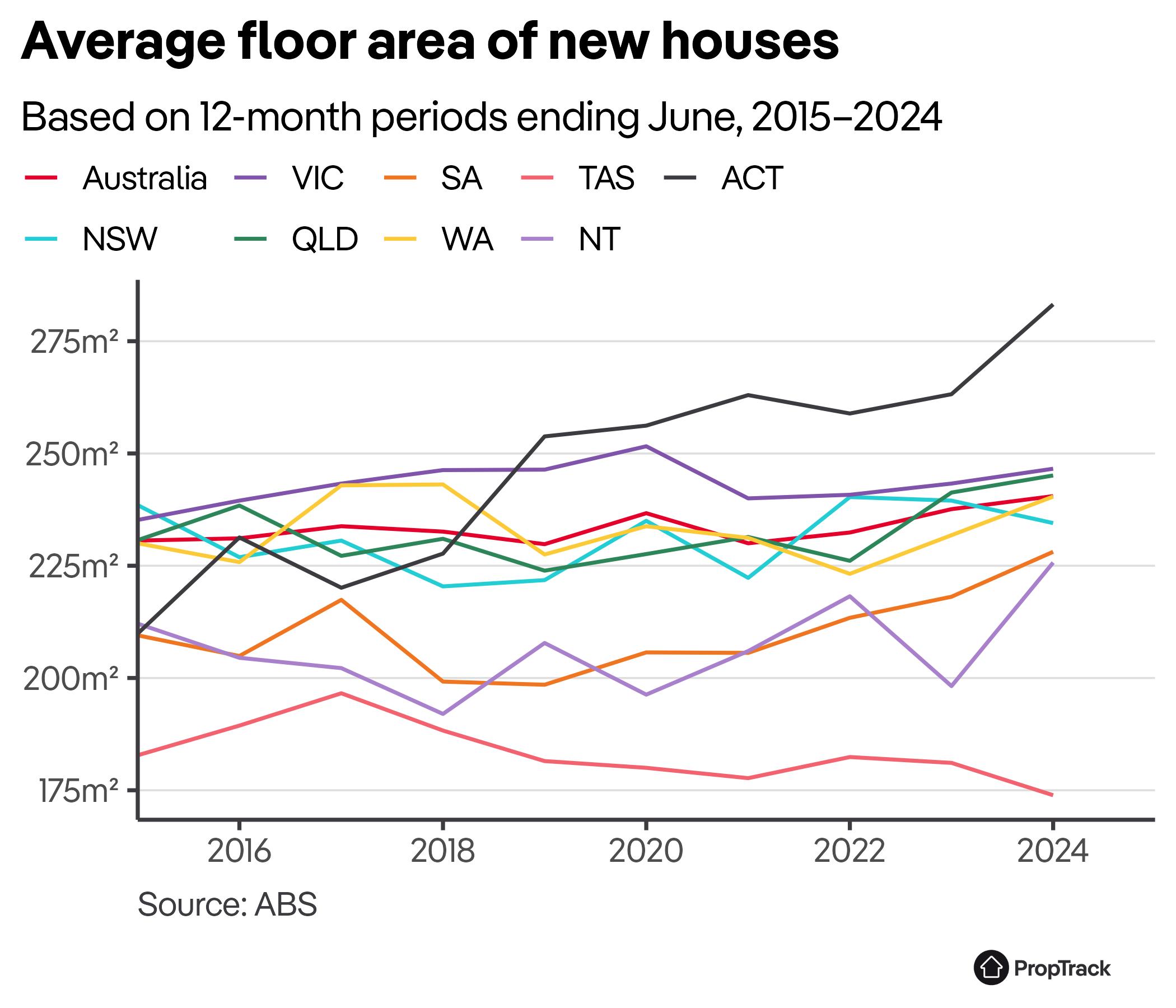
“At a national level, the average floor area of a newly built house is currently 241sqm,” Lieu said. “Over the past decade, the interior area of a house has consistently ranged between 230sqm and 240sqm.”
This trend holds across most states, with many new houses even growing slightly in internal space since 2015.
While private outdoor space has become scarcer, Lieu said “internal living spaces are still a priority for buyers and also developers who are focused on maximising land use.”
Looking ahead, smaller blocks and denser housing forms are likely to shape Australia’s next housing cycle.
“In the next decade, the composition of our cities is likely to evolve further with an increase in semi-detached and attached dwellings (townhouses and apartments), underpinned by planning and zoning reforms,” Lieu said.
“The block size of detached dwellings is projected to continue trending downward as land becomes more scarce and less affordable.”
However, Australians’ preference for generous internal living space remains unchanged.
“Despite this, we expect house sizes to remain relatively unchanged in the coming years as Australians continue to value generous internal living spaces,” the PropTrack economist said.
Get the hottest and freshest mortgage news delivered right into your inbox. Subscribe now to our FREE daily newsletter.