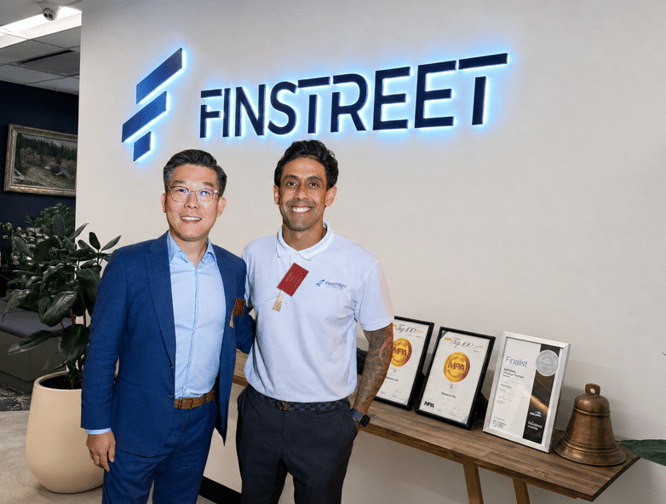
FINSTREET continues to up the ante.
The Sydney-based non-bank lender recently surpassed $1 billion in cumulative loan settlements, underscoring the firm's continued growth, as well as the broader expansion of Australia's non-bank lending sector.
"It's more than just a number. Every settlement represents a broker's trust, a customer's funding journey and the strength of the partnerships we've built across the industry," Darren Liu, co-founder and managing director at the firm (and pictured above left), told Australian Broker.
The milestone spans FINSTREET's mortgage management and private credit businesses, including loans delivered through its broker network and lending partners.
Liu said the milestone is the result of "both favourable market dynamics and years of consistent investment in our business."
The broader market has created fertile ground for non-bank lenders. Higher interest rates have prompted traditional banks to take a more cautious approach and tighten lending standards, while increasingly complex borrower needs are driving demand for greater choice and flexibility. Together, these forces have created a growth environment for non-banks, with both brokers and borrowers increasingly turning to alternative lenders to get deals across the finish line.
"Borrowers have not disappeared; rather, their circumstances are becoming more complex, and the market increasingly needs alternative sources of credit to complement traditional bank lending," Liu explained. "FINSTREET has grown within this environment by connecting brokers and borrowers with a broader range of non-bank and private credit solutions, particularly where conventional lending criteria may not fully accommodate otherwise viable borrowers or transactions.
"And as lending becomes more specialised, brokers are increasingly seeking reliable non-bank and specialist lending partners who can provide flexible solutions across a broader range of scenarios," he added.
Case in point, In December, FINSTREET received roughly $20 million in refinance applications in one week. Liu said, since then, the market hasn't slowed.
"It's evolved," he said.
In July, FINSTREET expanded its Easy Refi range to include low doc refinancing for self-employed borrowers, as well as refinancing from eligible lenders that do not participate in Comprehensive Credit Reporting (CCR).
"The strong uptake reinforces that there is still significant demand for the lending solution and highlights the importance of understanding niche segments of the market," Liu said.
"More broadly, we're seeing policy and economic changes continue to reshape lending opportunities," he continued. "Recent policy and budget changes are also creating new conversations around property investment, self managed super funds (SMSFs) and broader financing strategies. Rather than reducing activity, these changes are increasing the need for informed credit advice as borrowers navigate a more complex lending environment.
"That's why we believe the role of mortgage brokers has never been more important," Liu added. "Today's brokers are no longer simply comparing interest rates, they're helping clients understand policy changes, assess different lending options and make informed long-term decisions."
On the internal side, Liu pointed to four areas of investment over recent years that have helped grow FINSTREET building out credit expertise, expanding the firm's lender panel and specialist lending options, improving technology and operational efficiency, and increasing broker education and support. FINSTREET supports brokers across residential lending, commercial finance, SMSF lending, development finance and private credit.
"That breadth of capability allows us to help brokers solve more complex client scenarios while delivering a consistent experience," Liu said.
Liu was clear that the $1 billion figure is a checkpoint rather than an end point.
"Our focus now isn't simply on doing more loans, it's about building greater capability for brokers across Australia," he said.
Over the next 12 to 24 months, FINSTREET plans to expand FINSTREET Local, which partners with experienced brokers in key markets around the country. The model enables brokers to build and grow their own local businesses by way of FINSTREET'S national lending capabilities, technology, operational support and broader specialist lending ecosystem. The lender will also continue investing in its FINTOUCH technology platform. The platform offers AI-assisted workflows and better document management, aimed at giving brokers more time with clients and less time on admin. In addition, FINSTREET plans to keep broadening its specialist lending capabilities across residential, commercial, private credit, development finance and refinancing.
"Our vision is to build one of Australia's leading specialist lending capability platforms, not simply measured by loan volume, but by the value we create for brokers, lending partners and customers," Liu said.
"As the market continues to evolve, we believe the role of specialist lending will only become more important," he added. "And we're committed to continuing to invest in the people, technology and partnerships that help brokers grow their businesses."
Looking at the wider non-bank sector, Liu said he expects continued growth over the next six to twelve months, driven less by bank policy or interest rates, and more by the growing diversity of borrower needs: from self-employed applicants and SMSF investors, to those pursuing construction projects or requiring bridging and private credit solutions.
"I don't see the future as banks versus non-banks," Liu said. "I see it as a more collaborative lending ecosystem, where major banks, non-bank lenders and private credit providers each play an important role. The future isn't about replacing banks. It's about expanding choice and giving brokers access to a broader range of solutions for their clients."