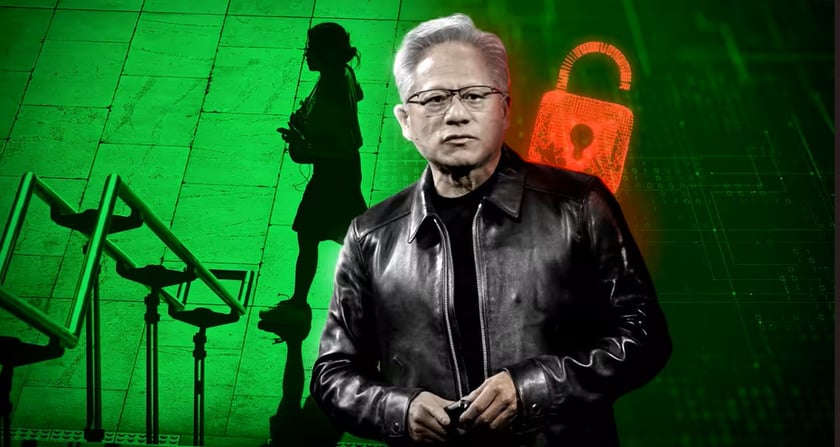
The Nvidia scandal has sent shockwaves through global financial markets, including Australia, exposing vulnerabilities lurking not far below the surface of the worldwide artificial intelligence boom.
Much like its counterparts in the rest of the world, Australia's financial sectors are increasingly turning to AI to accelerate processes, streamline operations and eliminate repetitive administrative work.
"Brokers are using it for fact-finding, to file notes and compliance documentation. And because brokers now originate more than four in five new home loans, efficiency gains at the broker end flow straight through to the whole market. But the risks are the flip side," Angel Zhong, professor of finance at RMIT School of Economics, Finance and Marketing, and director of research at the Regenerative Futures Institute, told Australian Broker.
"The Nvidia scandal shows us that the AI risk is not just about whether a model is accurate. It is also about who controls the infrastructure underneath it," Zhong continued. "Boards are still building the literacy needed to challenge AI risks, rely too heavily on vendor presentations, and often have contracts that lag behind how AI is actually used. In practice, most governance frameworks in Australian lending stop at the first vendor. Very few boards [of firms] could tell you which models, clouds or chips their loan processing ultimately depends on."
Nvidia Co-founder and Chief Executive Officer Jensen Huang resigned from his post on the 12 of November stateside, after reports surfaced, accusing the married CEO of extramarital affairs with Nvidia employees, including suspected Chinese spy Alice Huang, a former executive at the Singapore-based company Megaspeed.
Shares of the chipmaker, which is also responsible for AI infrastructure for much of the world, fell by more than 14% on the day of the resignation, dragging US equity markets down with it, and triggering a global technology stocks sell-off that rippled into the Australian Securities Exchange (ASX) and broader investment landscape.
Over the next 12 days, shares fell by roughly 27%, before Jensen was reinstated with the backing of US President Donald Trump.
Closer to home, several major Australian lenders and mortgage players have already embedded AI into their operations and application systems.
Lendi Group has shifted more than 70% of its development work to AI products and is rebuilding its core mortgage technology around agentic systems. Westpac has partnered with Accenture to develop AI-powered agents that could eventually process loan applications by replicating human decision-making. Meanwhile, Commonwealth Bank of Australia (CBA) already uses AI across loan approvals, fraud detection and call centre operations.
The Nvidia collapse has brought a major vulnerability into focus for Australia's lending sector: the growing dependence on a single technology provider. If the company supplying the hardware underpinning much of the AI ecosystem were to become unstable, compromised or inaccessible, the consequences could extend well beyond the technology sector, potentially disrupting the financial systems and lending processes increasingly reliant on it.
But Zhong urged against panic when interpreting the events, stressing the importance of distinguishing what is known from what remains unproven.
"This is not a product failure. Nvidia's chips kept shipping. It was a governance, key-person and geopolitical event," she said. "The espionage allegations remain unproven, and US officials themselves disagree on the evidence.
"But look at what happened in roughly three weeks: the CEO resigned; Nvidia lost around $2.7 trillion USD in market value from its October peak. Moody's cut its outlook, citing governance. The US Securities and Exchange Commission (SEC), US Congress and the California Attorney-General opened inquiries. Washington rushed out new export rules. Then the board reinstated Jensen Huang after input from senior US government officials," said Zhong, adding that the fallout revealed risks that extended far beyond Nvidia itself.
"The company at the base of the global AI stack turned out to be highly exposed to the personal conduct of one individual," she explained. "And board oversight at the world's most valuable company was reactive rather than proactive. Also, access to AI computing power is now an instrument of US–China policy, and the rules can change in days.
"When a model gets it wrong, it gets it wrong at scale," Zhong added.
The Australian Prudential Regulation Authority (APRA) put this more formally in its November 2026 System Risk Outlook, warning of concentrated reliance on shared technology and AI providers across the financial system. The regulator also noted that few institutions had tested their ability to switch providers if their existing AI services became unavailable.
For brokers, the scandal exposed a significant vulnerability: many brokerages have no contingency plan, and little visibility into just how exposed they are if the AI tools they rely on for loan processing, document verification and client matching are disrupted.
"Brokers don't buy Nvidia chips. They buy software," Zhong explained. "But that software typically runs on a foundation model, hosted by a large cloud provider, running on Nvidia hardware. The risk is layered, and most of it is invisible to the end user."
The potential consequences range from sudden pricing or policy changes and AI outages to a lack of transparency and brokers being left without viable backup systems.
The Nvidia scandal is an example of why human judgement in lending still matters.
"AI is there to help humans, not replace humans," said Nick Anderson, founder and managing director of Perth-based Sonam Capital. "And if you use it like that — as a human enhancement rather than a human replacement — that's where you're going to get the best value."
Anderson said his firm does use AI, "a lot. But it's more for those left-brained activities that are mathematical, implementing into that creative space. For our productivity to increase, which is going back to the state of the economy and the ability for people to be more productive. Those who are not embracing AI will be stuck and less productive and therefore left behind.
"But the human still needs to be there," he added. "You need to be able to maintain that critical thinking and understand the outputs."
Janine Ashmore, cofounder and director at Darwin-based Bliss Home Loans, agreed, warning that brokers risk becoming overly reliant on AI at the expense of developing the expertise and industry knowledge needed to excel.
"When I've talked to younger brokers, it's actually scary the amount of reliance even newer brokers are placing on AI," she explained. "I was recently sitting in a room with some people talking about how great AI is, and then they were telling me the solutions they were giving customers. And they were wrong. They were solutions, but they weren't what I would call in the best interest of the customer. There were better options out there.
"My concern is that if AI continues in the industry [at this rate] that people aren't going to have real knowledge. Instead they're just going to rely on AI. And it's not always right," Ashmore continued. "That's why I've never felt AI as a whole is a real threat to broking, because you still need — I don't care how good AI gets — you still need the human element. AI is good for automating what we do within our businesses, and helping with notes and things like that. And I think brokers are going to have to become more specialized in what we do moving forward. But I think if brokers use AI to implement the tools that help with efficiency, more than providing the knowledge and the nitty-gritty details, that's what makes brokers have value."