
The Mortgage & Finance Association of Australia (MFAA) has released a new international report — dubbed the Global Insights Report 2026 — comparing Australia's broking industry to that of the United States, Canada, the United Kingdom, The Netherlands and Germany.
Drawing on insights from more than 30 stakeholders across 15 organisations, including the US Consumer Financial Protection Bureau (CFPB), the UK Financial Conduct Authority (FCA) and the Dutch Authority for the Financial Markets (AFM), the report examines regulatory frameworks, broker remuneration, data and technology, emerging risks and evolving business models. It also highlights lessons that could help shape the future of Australia's broking industry.
"It didn't matter through what lens that we spoke to stakeholders in each of these jurisdictions, whether it was remuneration, regulation, technology, risk. One of the things that really stood out was, these are really big decisions that consumers are making. They're high-value stake decisions. And everyone just kept saying, 'people want people to trust,'" said Anja Pannek, chief executive officer of the MFAA. "So even though the markets are shifting, there are varying degrees of regulation, all of the markets saw the huge value that brokers brought to that conversation with consumers. That engagement between the broker and the client on a human-to-human basis was absolutely key."
The report is accompanied by a three-part video series, with the first instalment released on Wednesday. Pannek, along Executive – Policy & Legal Naveen Ahluwalia, lead discussions on key findings, emerging trends and the implications for Australia's broking sector.
Pannek said the industry body's conversation abroad reinforced the many strengths of Australia's broking industry, particularly the value brokers bring to consumers navigating major financial decisions.
That value is reflected in the channel's growing market share.
As of the June 2026 quarter, brokers facilitated 81.6% of all new home loans in Australia, according to data collected from research firm Cotality and commissioned by the MFAA.
Only two countries examined in the report surpass Australia's level of broker involvement, although their market share statistics cannot be compared on a like-for-like basis, as definitions and measurement methods vary across jurisdictions.
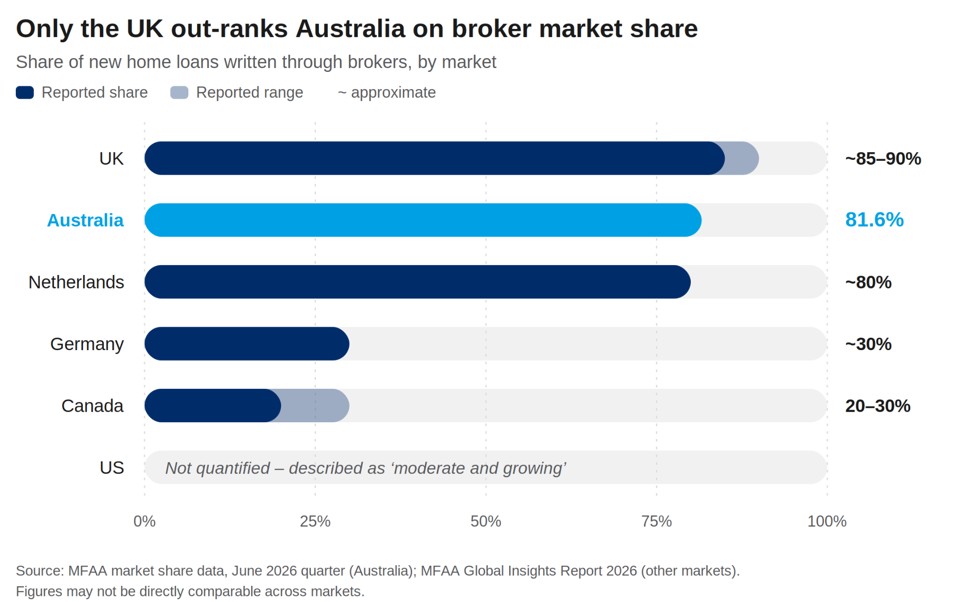
The UK leads the pack, with brokers responsible for 855 to 90% of mortgage lending. Advice is built into the regulatory framework through the Mortgage Market Review and the FCA’s Consumer Duty. While lenders pay advisers, many also generate revenue from protection and insurance products, with the option of charging clients fees.
In the Netherlands, brokers arrange roughly 80% of all loans, despite a comprehensive ban introduced in 2013 on commissions for complex financial products, including mortgages. Instead, consumers pay advisers directly, while lenders are required to levy a separate fee for advice.
Meanwhile, brokers write about 30% of loans in Germany. The market is regulated by the Federal Financial Supervisory Authority (BaFin). Advisers are paid by lender commission or client fees. In Canada, brokers write somewhere between 20% to 30% of all mortgages. The country shares a common law framework and lender-funded pay with Australia. However, it is regulated province by province. Fixed-rate loans dominate the market. Open banking, still in its infancy, continues to evolve.
The report offered no specific figure for the proportion of US mortgages arranged by brokers, characterising their presence instead as growing, but mid-range. They operate alongside banks, credit unions and mortgage lenders in an extensive wholesale market governed in part by the Dodd-Frank Act, introduced in the wake of the Global Financial Crisis (GFC). American borrowers typically take out fixed-interest mortgages, spanning 30 to 40 years, while open banking adoption is driven by industry initiatives rather than statutory requirements.
Australian Broker caught up with Pannek and Ahluwalia to find out where Australia’s broking industry leads the way, and what lessons it can take from its international counterparts.
Chief executive officer of the MFAA
“What stood out to me through our international research was the strength of Australia’s foundations. Our national regulatory and licensing framework allows broking businesses to support clients across the country, while the mortgage broker best interests duty underpins consumer confidence and differentiates the broker channel from going directly to a lender.
The relationships Australian brokers build are another real strength. Around 72% of business comes from repeat clients and referrals, which speaks to the value clients see in having someone they can return to as their circumstances change.
There is also plenty we can learn. Even in markets such as the United States, where AI is moving quickly, we heard about the importance consumers place on speaking with a person. Buying a home is a significant and often emotional decision, and technology creates opportunities to give brokers more time for those conversations.
Across the countries we visited, brokers were seen as advisers. There is an opportunity for us to continue leaning into that advice role in Australia, moving beyond the transaction and helping clients understand their options over time. That ongoing relationship can deliver value for clients and support stronger, more sustainable broker businesses.”
Executive – Policy & Legal at the MFAA
“Australia’s national regulatory model provides a consistent foundation for broking businesses to grow and operate across the country. Alongside that, strong consumer protections, including the mortgage broker best interests duty, support trust in the channel.
Internationally, we saw opportunities to use open banking more effectively within the mortgage application process. More comprehensive financial information can reduce manual information gathering, help brokers understand their clients’ circumstances and support more informed conversations.
Across the markets we examined, the adviser role was a consistent theme. Continuing to develop that aspect of broking in Australia, within our regulatory framework, can help deepen client relationships beyond the initial transaction. For broker businesses, that creates opportunities to demonstrate their ongoing value and build lasting relationships as clients’ needs evolve.”