By
All the headlines may appear to be doom and gloom as we rate for the next RBA hike – but there is a silver lining if you know where to look for it. Brokers can expect construction finance to stay in demand, with home approvals running near their highest level since early 2022.
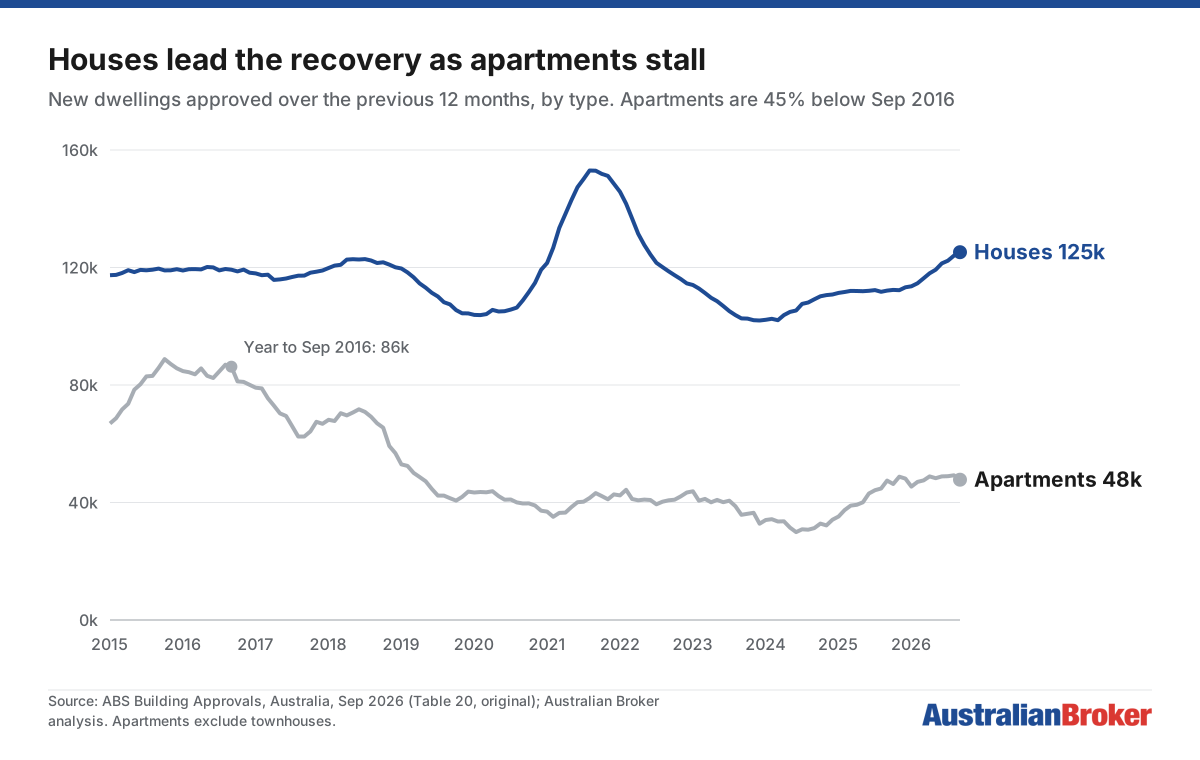
Australia approved 207,364 new dwellings in the 12 months to September, up 7.5 per cent on a year earlier, according to Australian Broker's analysis of Australian Bureau of Statistics data released on Monday. Detached houses drove the rise, up 11.7 per cent to 125,216, the most since May 2022.
Construction lending is growing even as the wider home loan market cools.
Owner-occupier loans to build a home rose 15.1 per cent in the year to the June quarter, to 9,975, according to an analysis of ABS lending data. Investors took out 8,468 construction loans, the most since the series began in 2019.
Overall, new home loan commitments fell 5.4 per cent in the June quarter to 134,225. Owner-occupier lending was 1.6 per cent lower than a year earlier, the first annual fall since September quarter 2023, ABS head of finance statistics Mish Tan said. First home buyer loans were flat on the year, at 29,319.
Brokers get the next read next week on 11 November, when the ABS publishes September-quarter lending figures.
The pipeline is growing, but not fast enough for the National Housing Accord. Under it, governments agreed to build 1.2 million new homes in the five years from July 2024, or about 240,000 a year.
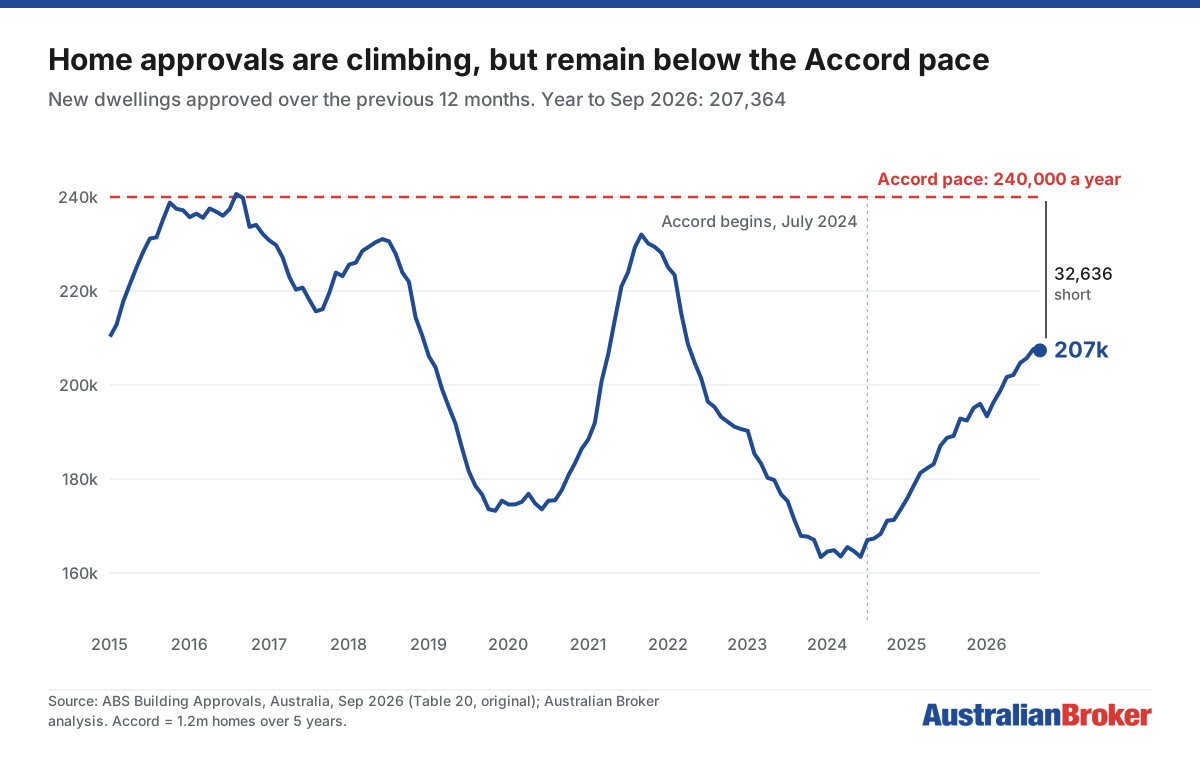
Since the Accord began, 446,350 homes have been approved: about 16,500 a month, against the 20,000 needed. Even if every approval were built, the country would be roughly 94,000 homes behind schedule.
Completions, which the target actually counts, are further behind. Australia completed 355,817 homes in the Accord's first two years, about 124,000 short of the required pace, AAP reported in October.
Seasonally adjusted approvals rose 5.1 per cent in September to 17,948 but industry groups were unconvinced that this was anything like enough. “September’s numbers are nowhere near the levels needed,” Master Builders Australia chief executive Denita Wawn said.
Apartment approvals barely moved over the year, edging up 0.6 per cent to 47,771. That is about 45 per cent below the year to September 2016.
Apartments are also getting dearer to build. The average estimated construction value of an approved apartment rose a whopping 26.5 per cent in a year, to $738,000, compared with a 4.5 per cent rise for houses, to $524,000. These are builders' estimates at approval, not sale prices, and part of the jump may reflect a shift towards pricier projects.
Melbourne was the only capital where approvals fell, down 10.1 per cent to 41,681 over the year.
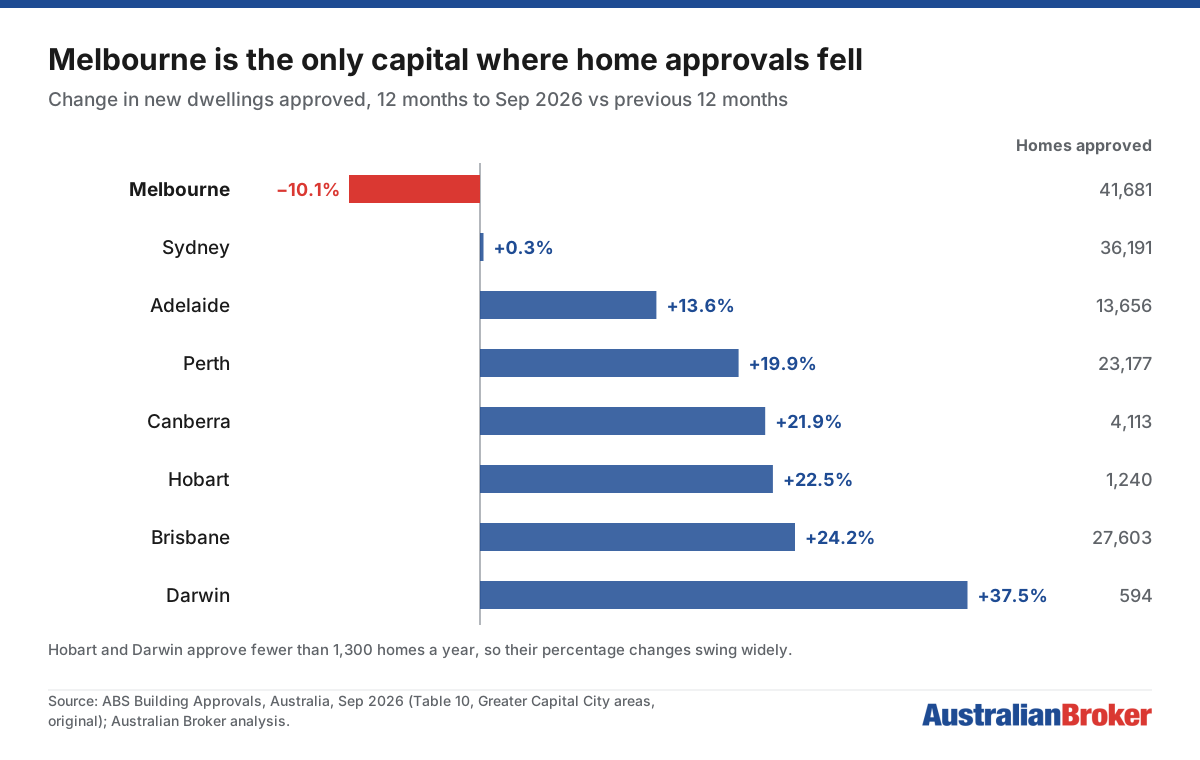
The slide deepened in September, when Victorian approvals fell 28.9 per cent in seasonally adjusted terms, according to the ABS.
Elsewhere, Queensland's 48,305 approvals were its most in a 12-month period since late 2016, and Brisbane led the big capitals, up 24 per cent. South Australia had its strongest 12 months since early 1977, and Western Australia its best since late 2021.
Sydney was flat. In NSW, house approvals rose about 15 per cent while apartment approvals fell about 12 per cent.