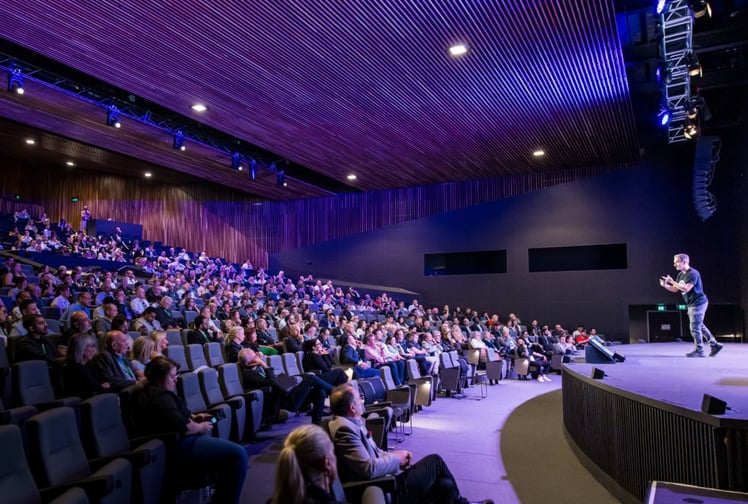
Some of the biggest names in finance and beyond descended on Sydney recently for the Finance Brokers Association of Australia's (FBAA) 2026 National Industry Conference (NIC), bringing plenty of big ideas, expert insights and a few unexpected talking points along for the ride.
More than 800 people showed up — including brokers, brokerage firms, lenders, aggregators and friends of the industry — packed the International Convention Centre (ICC) to hear from the speakers, exchange ideas and learn more about the challenges and opportunities shaping the industry.
The speaker line-up featured a mix of talent, including Courtney Houssos, New South Wales (NSW) minister of finance, domestic manufacturing and government procurement, natural resources; economist Warren Hogan; behavioural profiling specialist Natalie Waters; and documentary filmmaker and stuntman Todd Sampson.
Waters shared her insights on building trust in a digital world, while Sampson took things to another level, exploring how to confront fear and apply those lessons to everyday life. Naturally, he brought a few memorable examples, screening footage of his extreme stunts, including walking a tightrope 20 storeys above the ground and navigating his way out of a full-body lock while underwater.
Australian Broker was there on the ground, catching the action, insights and conversations at this year's conference, while chatting with attendees about their thoughts.
Matthew Nott, founder, principal lender manager and broker at Parramatta-based Avondale Finance, said he came for the speakers.
"Some are better than others, obviously," Nott told Australian Broker.
Jake Sanders, head of third party sales at non-bank lender Firstmac, said he enjoyed listening to Hogan's update on the economy.
"He was good," Sanders said. "I think he said a lot of things clearly that people are thinking in his own bullish kind of way."
Garth Davis, founder and chief executive officer of Perth-area investment firm Property Powerhouse, agreed.
"I thought the economist was really good and didn't beat around the bush," he told Australian Broker. "He could have just bored us crazy with statistics and graphs and things. But I think he was very good and I think he was very honest. And I really liked the way he was really identifying that the market was being driven by a lot of government spending, a lot of government expense and wages and overspending. And he wasn't sugarcoating anything. He was very concerned with where the economy was heading. He's concerned that there could be a recession around the corner. He didn't have to say that type of thing."
Davis added that all the speakers "were very good.
"And that's what I have noticed with FBAA generally, when they have speakers that come around the country, like when they have the FBAA roadshow," he said. "Because I'm based in Perth, and when they bring their roadshow around the country, they always have very good speakers. They're all very engaging."
In her address, titled "What's Next for NSW?," Minister Courtney Houssos provided an update on the state's housing market, describing an industry that has shown considerable strength while acknowledging the challenges that continue to hold it back.
Among the biggest concerns is housing affordability, with many young people being priced out of the NSW market and increasingly looking to other states to get a foot on the property ladder. It's also creating headaches for businesses, which are finding it harder to attract and retain talent when workers struggle to afford living in the state.
"I think the resilience of the industry is something that has certainly stood out, whether it's perhaps world events, perhaps it's changes to government regulation," Houssos said.
But she also added: "unless we address the housing challenges, it will continue to breed other problems. It's holding us back. And we know we've got lots of opportunities here in New South Wales and in Sydney. Sydney is literally our gateway to the world. But for too long our housing crisis has been limiting our potential. We can't afford to keep losing our young people to other states when they can no longer rent or buy here. And businesses shouldn't need to struggle to attract and retain talent that they need. We know the only sustainable way to make housing more affordable is to build more of it in places where people want to live. And we're continuing to do our part, as well to help more people get their foot in the door of homeownership."
In her update, she said that since July 2023, more than 94,000 first-time homebuyers have received direct financial support from government schemes, with the average assistance around $20,000. In addition, in the coming year, roughly 30,000 more first-time homebuyers will receive support, she said.
"Helping people into the market is only part of the answer," Houssos said. "We also need to tackle the structural issue at the heart of the housing crisis. And that's supply. That's why we've changed the rules to build thousands of new homes around train stations. It's why we backed it up with the biggest investment in social housing since World War II. And it's why we established the [government specialist panel] Housing Delivery Authority, which is streamlining assessments for new homes and helping us deliver more homes. Getting housing right is central for what comes next for New South Wales. And what this all comes down to is building a more robust economy, an economy that can weather whatever storm that comes our way, where households feel supported through challenging times, and where businesses have the confidence to grow and get ahead.
"We're not pretending everything's fixed," she added. "And we're certainly not saying that the job is done. There are real challenges facing our state. But we believe that our government has laid the foundations and there's lots more work ahead of us. Our plan is to continue to make practical reforms that make a real difference to people's lives while securing the future of New South Wales."
Beyond the economic challenges facing the industry, Houssos also highlighted the value of face-to-face connections, particularly in an increasingly digital world. While technology has transformed the way businesses communicate, collaborate and build relationships, she suggested that the pandemic served as a reminder that not every interaction can be replicated through a screen.
"When we talk about disruption, and we talk about some of the challenges, probably the most obvious one that comes to mind in recent years is the COVID-19 period," she said. "And I think one of the things that we really learned during that period, certainly one of the reflections I took away, was that we can do a lot of our stuff on screens. And I'm sure you do a lot of your stuff on screens. It enables us to communicate with people in different ways that we didn't used to. But we still love getting together."
Economist Warren Hogan delivered a frank assessment of the global and Australian economic landscape, arguing that rapid changes in demographics, technology and geopolitics are reshaping the way businesses operate, while policymakers are struggling to keep pace.
Hogan, founder and managing director of specialist economic research platform EQ Economics and chief economic advisor at Judo Bank, explored these issues in his presentation, titled "How Demographic Change and New Technology are Reshaping the Business Operating Environment."
"My proposition is that the world's changed and our leaders haven't got [the message]. And therefore they need to change the way they tax, the way they regulate, the way they set what we might call economic parameters, economic reform, just to keep the thing going," he said. "But because they're not, the wheels are coming off the bus, uncertainty's rising, then the politics gets bad, and it's obviously reached a crescendo this year with the geopolitics."
Turning his attention to Australia, Hogan pointed to the country's inflation challenges and exposure to international economic shocks, suggesting the combination was putting further pressure on an already difficult domestic environment.
"As we see right here today, we're in trouble," he said. "We've got domestic inflation and then we get an international shock, which just magnifies through the economy. And now we've got inflation well above both core and headline, above anyone else in the advanced economy. And we just don't know what the Reserve Bank of Australia (RBA} is going to do. I think the penny's dropped for them. I mean, you know, they are very smart people up there. But they sort of don't get it."
While Australia's unemployment rate is slowly rising, offering the first signs of a slowing economy, Hogan warned that businesses are still facing a significant shortage of suitably qualified workers.
"And it is going to get worse and worse and worse and worse," he said. "This labour shortage, this hard-to-find worker issue. So how do you deal with labour shortages? If you're a firm, and you can't find a carpenter here in Australia, here in Sydney, you go to the U.K. [for example], you find a carpenter, you find a visa program, you bring them in. You've solved your firm-level labour shortage.
"But as soon as that carpenter arrives in Australia from the U.K, with or without family, they need a house, a road, a Bunnings, a hospital. So it doesn't change the balance of the economy," Hogan continued. "Immigration will help at the margin; it is a positive force, especially if it's focused on skills and the right working age. But it doesn't solve it.
"The bottom line is technology is the only way to get over this macroeconomic shifting balance," he added. "Because we don't have a widespread understanding of this problem to start with; it's only very new."