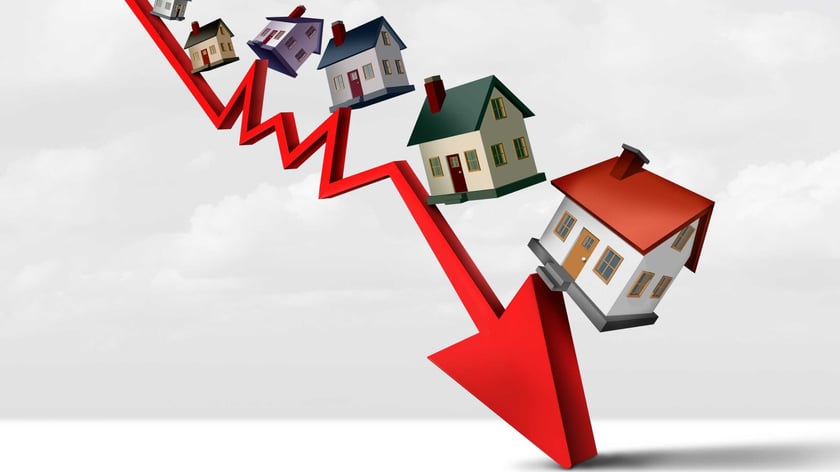
Buyers are gaining the upper hand in Australia's property market, as falling prices and softer conditions give aspiring homeowners and brokers more room to negotiate.
During the winter quarter, or the three months ending 31 August, house values dropped in all of Australia's capital cities, with the exception of Darwin. Dwelling prices fell -0.9% in August, or down -3.1% during the quarter, according to Cotality's most recent national Home Value Index. The results mark the fifth month in a row that prices in most of Australia's capital cities have declined.
"It's absolutely a buyer's market," Nerida Conisbee, chief economist at Ray White, told Australian Broker.
"It'll probably continue for a little while longer; it's definitely very weak out there," the economist continued.
Meanwhile, higher-priced homes in most capital cities continue to underperform the more affordable properties. But that gap is narrowing, as the downturn spreads across more segments of the market, the report found. Properties are also taking longer to sell, with buyer demand weakening and more homes sitting on the market. In the four weeks leading up to 30 August, capital city listings were 24% higher than a year earlier.
For buyers, the combination of falling prices and weak demand is creating a market where sellers may have less leverage and negotiations can become more favourable.
Tim Lawless, Cotality’s executive research director for the Asia-Pacific region, added that the downturn is no longer confined to Sydney and Melbourne, or the higher ends of the market. It is now broadening across Australia’s capital cities and reaching a much wider range of properties.
"What started as a more concentrated easing across higher-value segments has now become a much more generalised softening, with the vast majority of capital city suburbs recording some level of decline," he explained.
A combination of factors have been weighing on Australia’s property market in recent months, from higher interest rates and reduced borrowing capacity to the latest federal budget and ongoing global uncertainty, putting further downward pressure on property prices.
"At the end of last year, we had three interest rate cuts. There was a fairly high degree of optimism [in the market]," Conisbee said. "But since the start of this year, we've had three interest rate rises. We've had a war in the Middle East; we've had consumer sentiment hit a record low. Business sentiment's low. We've got rising unemployment. Inflation is still high. We may have more interest rate rises. So there's just been a whole continuum of bad news coming through.
"And then, of course, the budget was also very challenging because it has led to a high degree of uncertainty as to what the changes will mean, and particularly, the withdrawal of investor activity, which is also impacting the market, particularly the cheaper end of the market," the economist continued.
For existing homeowners, the current downturn is bad news, at least for now. For aspiring buyers, however, it could present a window of opportunity, particularly if they move quickly.
Conisbee said the downturn could prove to be "quite short term," as the rising cost of replacing Australia’s housing stock, or building new homes, puts a floor under property prices.
"There's only so far that replacement costs can increase without affecting how house prices move," she explained. "Because if the cost of building a new home is too expensive, people move into the established market. That will keep pricing far more elevated. And then, of course, housing supply — which is well documented that we're still not delivering enough homes — is getting worse. And that will also mean that prices don't fall as much as many of the predictions are coming out at the moment."
According to the latest figures from the Australian Bureau of Statistics (ABS), building approvals, the first step in the construction process, are falling. The total number of dwellings approved dropped 3.6% in July. In the year ending in July, only 206,312 dwellings were approved. That's short of the 240,000 new homes that would need to be fully constructed each year in order to achieve the Labor Party's pledge to deliver 1.2 million new homes by 2029.
Beyond the ongoing housing shortage, Conisbee pointed to another factor weighing on the market: buyer psychology. When prices are declining, many prospective buyers become hesitant to commit, instead waiting for greater certainty before making a move.
"Buyers don't like markets where prices are falling. As a result, we tend to see pretty low levels of activity until people start to feel that the market is reaching a plateau," the economist said. "People's psychology is that when prices are falling, they don't want to get caught paying too much for a property. They're trying to time the bottom. And as a result, they just sit on the sidelines and wait.
"It happens in every cycle," Conisbee continued. "When people feel like the bottom has been reached, that's when they pile in. That's why we tend to see pretty sharp recoveries. That will likely happen again."