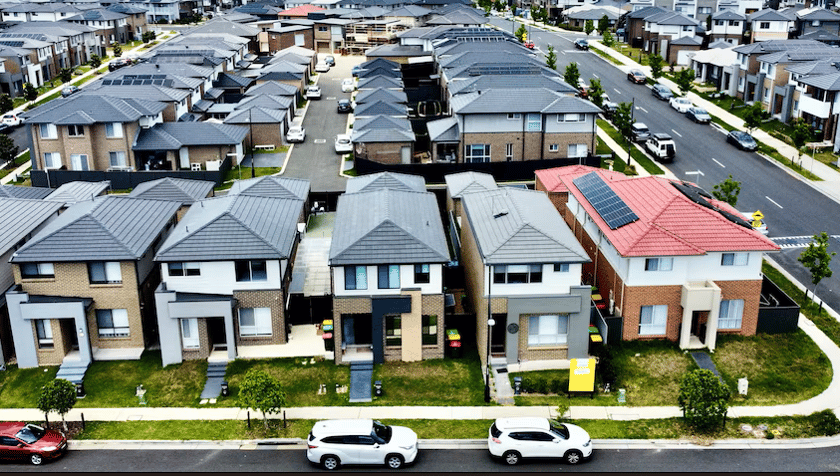
Housing approvals fell in July, putting a near-term turnaround in housing supply further out of reach.
The total number of dwellings approved dropped 3.6% in July to 17,687, on a seasonally-adjusted basis, according to the latest figures from the Australian Bureau of Statistics (ABS).
Approvals for private sector houses declined 4.2% to 10,199, while private sector dwelling, excluding houses — such as units and apartments — were down 0.4% in the month to 7,119. The value of total residential buildings approved decreased 4.9% to $11.26 billion, while the value of total non-residential building approvals was up 14.4% to $9.93 billion.
"This marked the largest monthly decline in the private house series since 2024," economists at ANZ wrote in a note.
"Over the last six months there has been a modest upward trend in building approvals," they continued, "however, we do expect the series to moderate over the coming months as feasibility challenges and restrictive interest rates slow demand."
By state, July approvals for all dwellings were mixed. Queensland, New South Wales and Western Australia all had declines, year-over-year: -13.9%, -8.1% and -0.3%, respectively. Meanwhile, approvals rose in Tasmania, Victoria and South Australia, up 15.2%, 9.7% and 5.9%, respectively.
Private sector house approvals were down across the board, with South Australia, Queensland, Victoria, New South Wales and Western Australia all reporting declines: down -10.7%, -5.5%, -4.1%, -4.0% and -0.1%, respectively. No data was available for Tasmania.
The latest figures underscore the scale of Australia's housing challenge. Building approvals are just the first step in the construction process, and not every approved dwelling ultimately gets built. As a result, the most recent approval numbers are merely an estimate to the number of new homes that will eventually be delivered.
Daniel Rossi, head of construction statistics at ABS, pointed out that there is some upside in the latest data, such as approvals for private sector houses and private sector dwellings excluding houses up 6% and 19.9%, respectively, over the year.
The July figures come as Australia continues to grapple with a chronic housing shortage. In 2023, Prime Minister Anthony Albanese pledged to deliver 1.2 million new homes by 2029 under the National Housing Accord. In order to achieve that, roughly 240,000 homes would need to be built each year. In the year to July, only 206,312 dwellings were approved. With fewer projects entering the construction pipeline, that target is looking increasingly difficult to achieve.
Headwinds include higher interest rates and inflationary pressures, both of which have increased construction and labour costs.
Meanwhile, markets have been buzzing with speculation about further interest rate hikes after the latest consumer price index (CPI) showed inflation remains above the Reserve Bank of Australia’s (RBA) target range.
The Labor Party has responded in recent months with a flurry of housing reforms designed to boost access for owner-occupiers. Some measures have sought to curb investor activity — including new restrictions on negative gearing and changes to tax breaks for holiday homes — in an effort to free up more housing stock for owner-occupiers. At the same time, the government has expanded support for first-time homebuyers through a range of schemes meant to help aspiring homeowners overcome affordability barriers.