
Regional valuations continue to outpace metropolitan markets, driven by strong internal migration, lifestyle preferences, and hybrid work patterns, according to the latest insights from NAB.
NAB’s 2025 Regional & Agribusiness Horizons Report showed that valuations for regional property continued to climb throughout 2024 and into 2025, reflecting sustained internal migration and renewed interest in rural living.
The report highlighted strong resilience and opportunity in regional Australia, with population growth, migration, and regional resilience driving rising property values across most states.
Median regional property values rose by 5.3% over the past 12 months – outstripping capital city growth of 2.6% and pushing the average to $673,373 by April 2025.
“Regional property valuations had another stellar year, led by ongoing internal migration,” said Mark Browning (pictured), national head of valuations and property advisory at NAB. “Values are now 58.7% above pre-COVID prices and sitting at a peak in April 2025.”
Data from the Regional Australia Institute showed that internal population flows remain 8.3% above pre-pandemic averages, despite a slowdown from COVID-era highs.
Recent insights from the March 2025 Regional Movers Index showed that regional migration remains significantly elevated.
Victoria led all states with 34% of net regional inflows, up from 28% a year earlier. Greater Geelong topped the list of destinations, capturing 9.3% of internal migration and overtaking Queensland’s Sunshine Coast.
Browning noted that hybrid working has become a lasting fixture, and lifestyle benefits continue to attract “treechangers” to regional areas.
“It seems settled that remote and hybrid working is here to stay – in at least some form. Equally as important, treechangers continue to recognise the lifestyle benefits of the country,” he said.
Queensland recorded standout results with seven of the top 10 highest-growth regions, driven by strength in coastal areas like the Gold Coast and Sunshine Coast, and extending inland to Toowoomba and Far North Queensland.
“Queensland property valuations had another winning run in the year to April 2025: beautiful one year, perfect the next,” Browning said.
Western Australia doubled its 2023 growth rate to 16.1% in 2024, with annual growth still strong at 13.2% as of April 2025. South Australia followed closely at 12.9%. These gains were largely attributed to interstate migration and strong local economies.
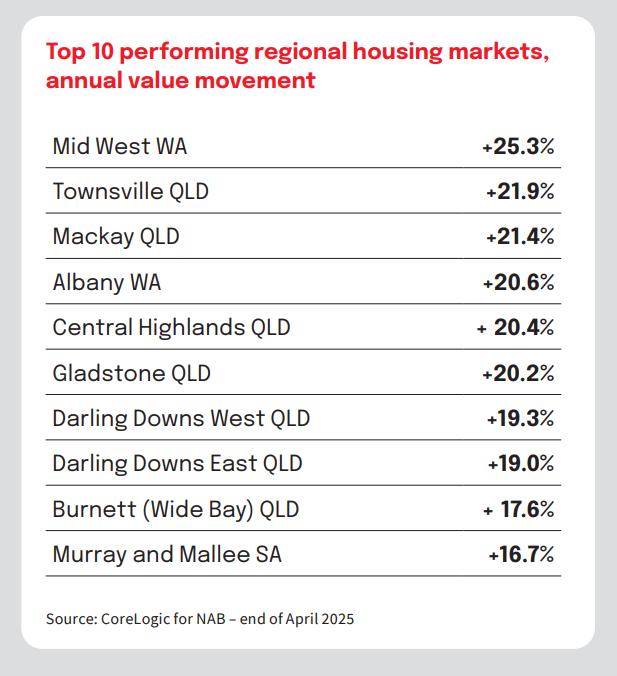
While Greater Geelong remained a top regional hotspot, Victoria overall posted a -0.9% annual growth rate by April 2025. This was still ahead of Melbourne’s -2.2%, suggesting regional resilience amid tax and policy challenges.
“Victoria was impacted by weaker conditions in 2024 including the state’s land tax on investment properties,” Browning said, noting that growth had resumed since February.
Amid concerns over housing supply and construction delays, the 2025–26 federal budget introduced targeted housing measures. These include:
“The challenges of the construction industry are not a new story, nor is it unique to Australia,” Browning said. “But these measures could provide much-needed relief and unlock supply.”
Foreign demand also buoyed the market in 2024, with US investors purchasing over 265,000 hectares of property worth more than $1.2 billion.
In 2025, NAB expects sustained interest across high-value rural property segments.
“In 2025, we expect strong activity and valuations in the $25m+ and $50m+ segments, given the continuing appeal of agricultural property to foreign investors and high net worth buyers,” Browning said.
Owner-operators are also active in the $5–$15 million range, positioning themselves for growth as interest rates begin to ease.
“We welcome housing increase measures and announcements to unlock supply,” Browning said. “On the outlook, we expect the remainder of 2025 to see all property types benefit from the expected easing in interest rates.”