Once seen as an aspirational milestone, the $1 million property has become the norm in many parts of Australia.
New analysis from Cotality (formerly CoreLogic) revealed that over a third of homes nationwide are now valued at $1 million or more, with that amount securing less property and fewer options than ever before.
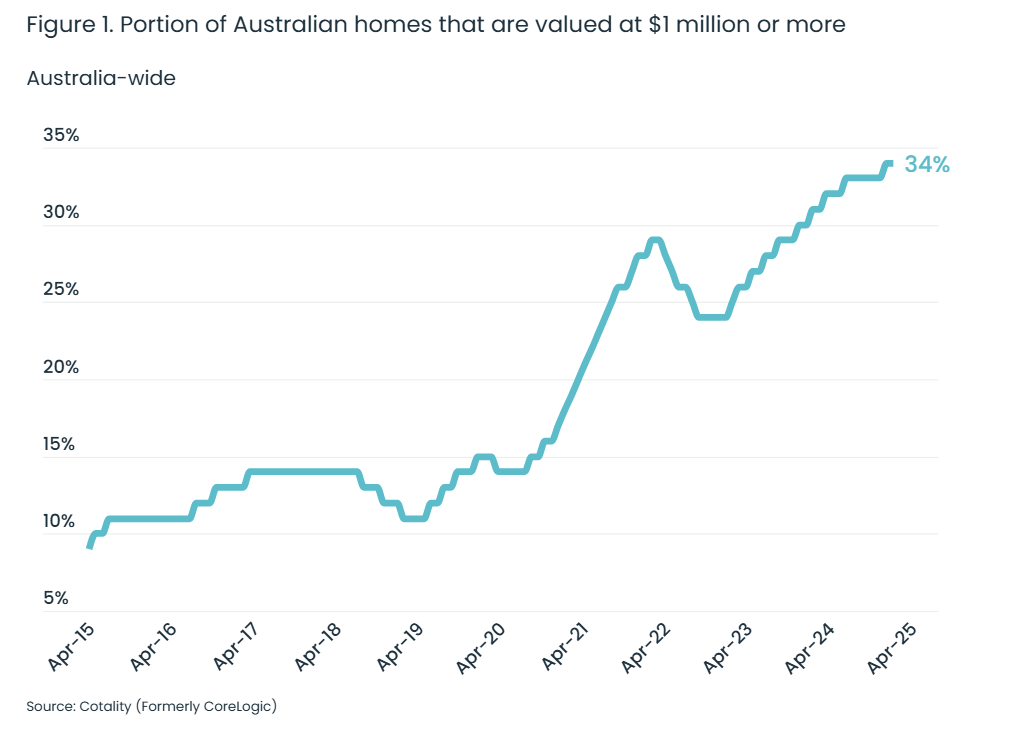
The share of $1 million-plus homes across Australia has surged dramatically. In April 2015, just 9.7% of homes were worth $1 million or more. As of April 2025, that figure has climbed to 34.4%—a record high.
In the capital cities, 41.6% of all homes now sit above the million-dollar mark, compared to 14.3% a decade ago.
The trend is even visible in regional areas, where million-dollar properties now make up 19.4% of the market, up from just 0.5% in 2015. This shift reflects long-term national growth, with housing values increasing 67.3% in the past decade.
“In August last year, the median house value across the combined capitals surpassed the million-dollar-mark, breaking the perception that Sydney was the only millionaire’s club for homeowners,” said Eliza Owen (pictured), Cotality’s head of research.
Sydney still holds the largest share of million-dollar homes—64.4% of the market, with a median value of $1.195 million as of April. What $1 million buys in the Harbour City has shrunk dramatically: where it once secured a five-bedroom home, it now barely stretches to a two- or three-bedroom house in some suburbs.
Brisbane is Australia’s fastest-rising million-dollar market, with 40.2% of homes now valued above $1 million, up from just 2.8% a decade ago. The city’s median house value currently sits at $990,000, and at current growth rates, is projected to exceed the $1 million mark by the end of the year.
These trends underscore the growing affordability pressures in capital cities—one of the key reasons buyers have increasingly looked toward regional and satellite cities for better value, particularly during and after the pandemic.
Melbourne ranks third with 30.9% of dwellings in the $1 million-plus range. Though down from a 2022 peak, the share has risen in recent months.
Adelaide and Perth have also seen rapid increases, driven by pandemic-era growth—Adelaide now has 27.8% of homes at or above $1 million, up from 4.2% in 2020.
By contrast, Hobart’s share has declined. The portion of million-dollar homes fell from 20.3% in March 2022 to 11.9% in April 2025, driven by weak economic and population growth, and rising interest rates.
Darwin remains the most affordable capital city, with just 1.3% of homes above the million-dollar threshold, consistent with its stagnant price performance over the past decade, Cotality reported.
Australia’s growing cohort of $1 million properties reflects rising household wealth—but it also underscores deepening inequality in access to housing.
The strain is particularly evident for younger and lower-income households. With wages failing to keep pace with rising property prices, many are forced to delay homeownership, increasing competition and pressure in the rental market.
With more properties surpassing the million-dollar mark, Australia’s wealth divide is deepening. As values rise faster than incomes, households with existing real estate holdings see equity and investment capacity grow—while others fall further behind.
“As values continue to rise, the chance that homeowners hit millionaire status increases, opening up new opportunities for further investment, or accessing that wealth through the sale of a property,” Owen said.
The shift toward a $1 million housing benchmark signals more than just market momentum—it’s a broader reflection of Australia's economic trajectory, affordability challenges, and future policy pressures.
For both first-home buyers and policymakers, the question now isn’t just “what can $1 million buy?”—but how long will it take to get there at all.