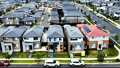
House prices continue to fall across the nation, and Sydney is no exception.
According to Cotality's most recent national Home Value Index, home values fell -0.9% nationally in August, or -3.1% during the winter quarter. Sydney led the declines on both accounts, down -1.4% last month, or -4.7% for the quarter.
But Sydney is a dynamic market, and continues to attract would-be homeowners, investors and transplants despite the downturn. The median house value in Sydney remains north of $1.22 million, the highest in the nation by far, according to the research firm.
"Sydney is still Sydney; people want to live here," Kimberly Linder, owner, director and finance broker at Xcel Finance, told Australian Broker.
For Australian Broker's latest Spotlight Series — where we highlight standout professionals across Australia's mortgage and finance industry — we caught up again with Linder. The Sydney-based brokerage owner shares her insights on Sydney's housing market, how it's what sets it apart from the rest of the country, whether the downturn has more room to run, and what she expects as we enter the back half of 2026.
The following interview has been edited for grammar and clarity.
KL: I think Sydney is a really interesting market at the moment and probably not for all the right reasons. Sydney has always had that combination of strong demand, limited supply and very high property prices. So affordability has been a huge challenge for a long time. But I think we’ve now got another layer of complexity with interest rates, construction costs, housing supply and, of course, government policy. I’ll probably get myself into trouble saying this, but I do think [the government] is quietly killing the market a little bit. The recent changes around investors and tax concessions have definitely changed sentiment. We’re seeing investors become much more cautious, and lending activity has dropped quite significantly.
KL: I think the decline we’re seeing in Sydney property values will be relatively short lived, and ultimately I believe the traditional fundamentals of property will prevail. At the end of the day, you can’t manufacture more land, particularly in a city like Sydney. And we’re still not building enough homes to keep up with the demand for housing. Australia is currently falling short of the pace of new housing construction that we need. So I think the underlying supply and demand imbalance is still very much there. Sydney is still Sydney; people want to live here; we have limited land, strong population demand and a housing shortage. You can slow the market down, but you can’t suddenly create thousands of extra blocks of land in the locations people want to live. I definitely think there may be more bumps in the road. But I'm not expecting this to be a long-term story of declining property values.
KL: From our perspective, we’re as busy as ever and we’re continuing to meet our monthly targets, which I think says a lot about the underlying demand that is still there. That said, inquiries have definitely slowed a little compared with this time last year, and I’m seeing more people sitting on the fence. There is a lot of uncertainty around rates, property values and government policy. So I think some buyers are simply waiting to see what happens next. That broader caution is showing up in the lending numbers as well, particularly among investors.
Our largest client base is investors, and I think one of the advantages of working with investors is that many of them understand the difference between timing the market and time in the market. They tend to have a longer-term view. They’re not necessarily making decisions based on what property prices are doing this month or next month.
From a broker’s perspective, one of our biggest challenges continues to be servicing. I genuinely believe the way servicing calculators are applied can be overly conservative. The 3% serviceability buffer is still in place, meaning borrowers are assessed on their ability to service their loan at a rate three percentage points higher than the actual loan rate. Of course, I completely understand why we need responsible lending and appropriate safeguards. But I do question whether the margins being applied are sometimes keeping perfectly capable buyers out of the market. In some cases, I think borrowing capacity, rather than the actual property price, is the bigger barrier.