
Brokers could be forgiven for thinking the capital gains tax fight was done and dusted. It isn’t.
The Greens hold the Senate numbers Labor needs to pass its remaining budget bills before summer. They have now signalled interest in a rival CGT model from Wentworth independent Allegra Spender. With the Coalition opposed to the whole package, the government’s latest CGT bill could be parked in a Senate inquiry over the break.
“They’re very interesting proposals, and we’re having a look at those now,” Greens economic justice spokesman Nick McKim said of Spender’s plan. He added that his party would be happy for the bill to go to an inquiry over summer. If that happens, the final shape of the regime may not be settled until 2027.
It’s an early test on tax for new Greens leader David Shoebridge, who replaced Larissa Waters at the end of September.
The big property measures aren’t up for grabs. Labor’s overhaul passed parliament in June with Greens support and is now law. The key changes for investors are:
New builds also got a sweetener that often gets missed. As the Treasurer set out in his second reading speech, investors who buy a new build can choose either the 50% discount or indexation when they sell, whichever works out better.
The fight is over a follow-up bill, the Treasury Laws Amendment (Tax Reform No. 4) Bill 2026. It was introduced on 27 October, has cleared the House and now sits in the Senate.
Its centrepiece is the Innovative Business CGT Concession, or IBCC. The concession lets founders, staff and early investors in qualifying start-ups keep a 50% discount, because a business that starts from a near-zero cost base gets almost nothing from indexation. The government loosened the rules after consultation, cutting the minimum holding period from five years to three and scrapping a $10 million lifetime cap. A $50 million turnover ceiling and an innovation test remain.
Spender’s argument is that indexation “just doesn’t work for businesses and shares”, and that patching it with carve-outs only adds complexity.
The proposal scraps the IBCC and splits assets into two groups:
The 40% figure is close to what the 2010 Henry Tax Review recommended. Spender’s paper says it would cap tax on nominal gains at roughly 28% for top-rate taxpayers.
The numbers have been checked. A Parliamentary Budget Office costing released on 28 October found the plan would improve the budget by between $590 million and $910 million over the forward estimates. That’s because it removes the IBCC and offers a smaller discount. The PBO did warn that it had to estimate which gains count as “active” using company income data, because direct figures don’t exist.
Business groups have lined up behind it. Both the Australian Industry Group and the Australian Chamber of Commerce and Industry support it, and so do a number of start-up founders.
[Insert chart 1: Who pays what]
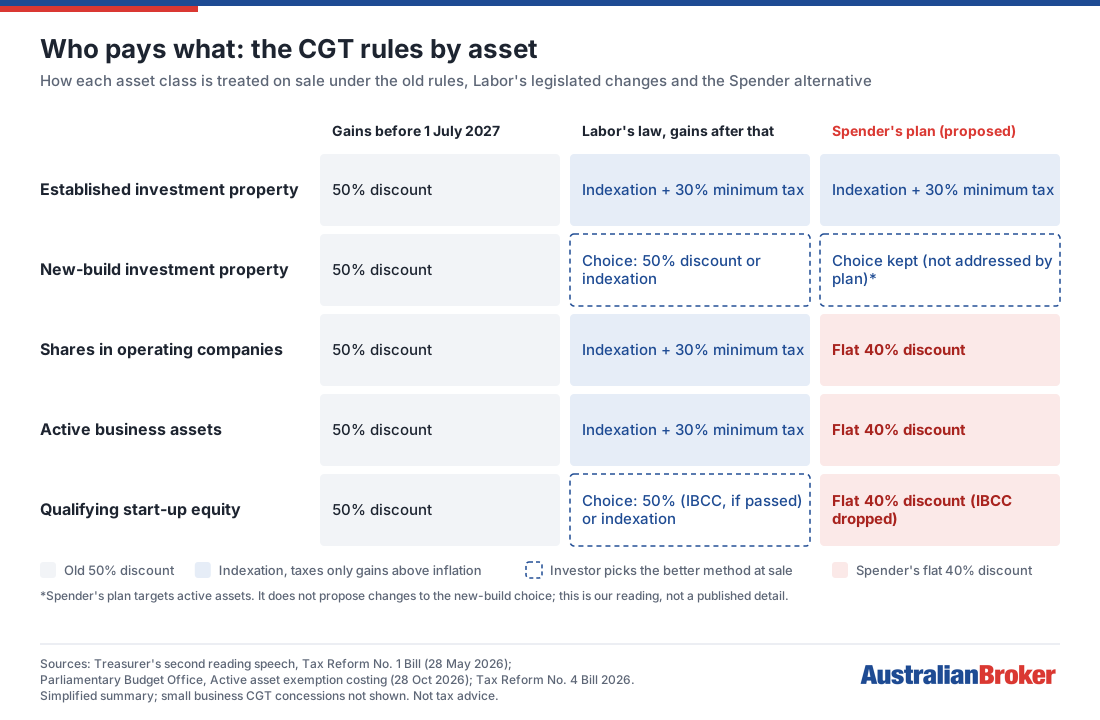
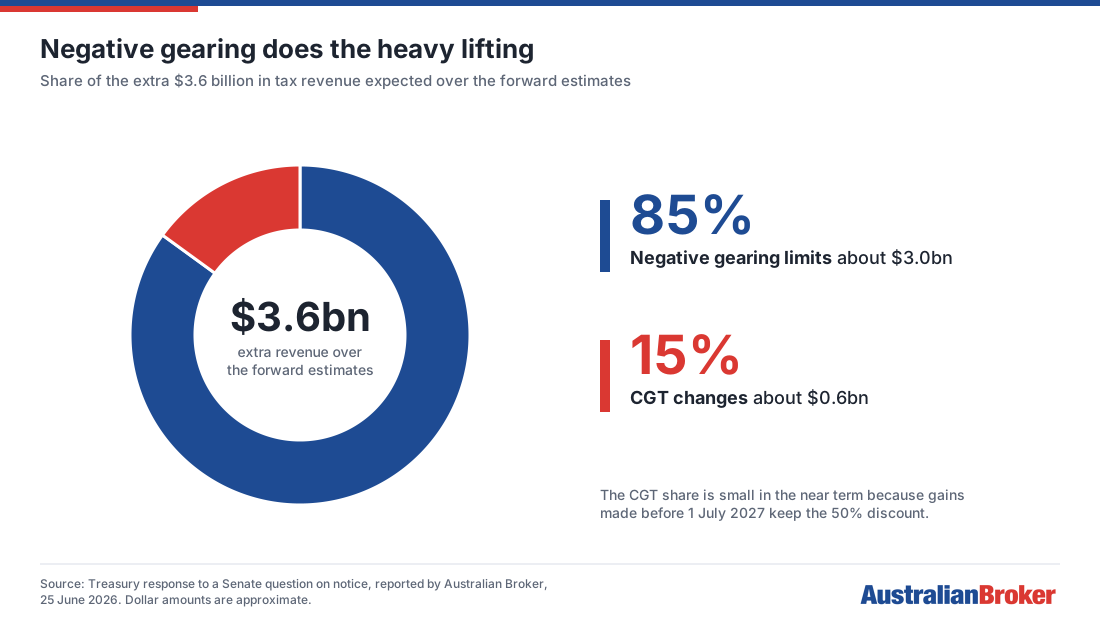
Directly, not much. An established investment property bought after July 2027 is taxed on its real gain with the 30% floor under both Labor’s law and Spender’s model. Her plan doesn’t touch negative gearing either, which matters more for property anyway. Treasury figures show about 85% of the extra $3.6 billion expected over the forward estimates comes from the negative gearing limits.
[Insert chart 2: Negative gearing does the heavy lifting]
New builds would look even better. Spender’s plan doesn’t propose changes to the new-build choice. On our reading, that would leave new-build investors able to claim a 50% discount while shareholders and business owners were capped at 40%. That would widen the tax edge new builds already have, at a time when the government wants investors funding fresh supply.
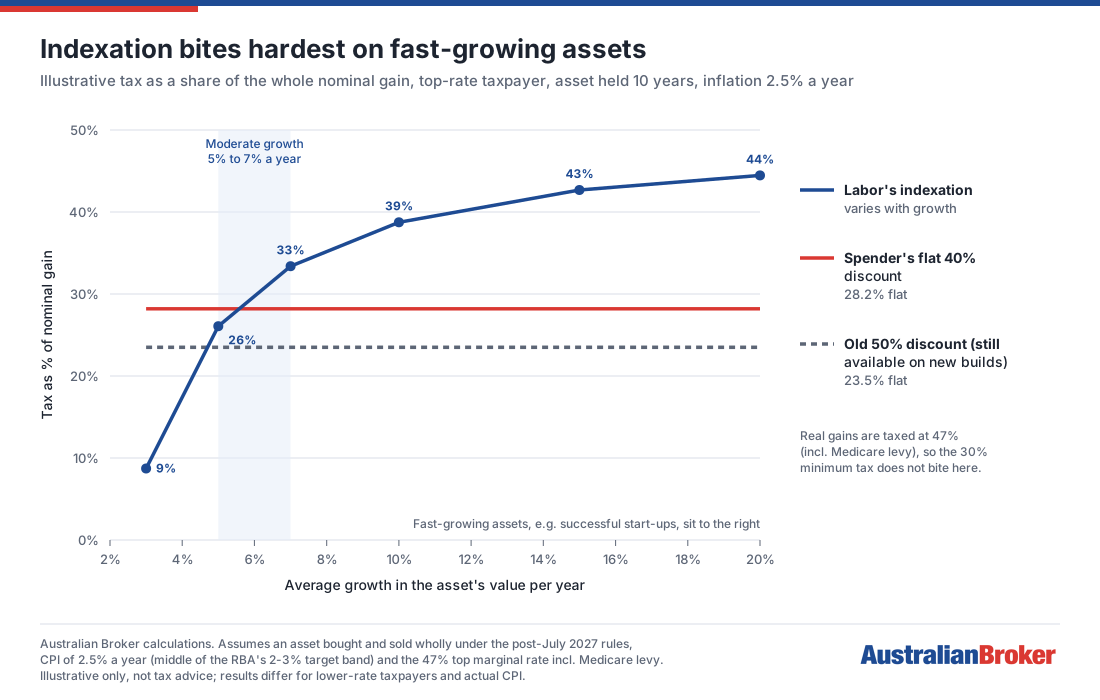
Growth rates matter. Indexation is kind to assets that grow modestly and tough on fast-growing ones. Our illustrative modelling of a top-rate taxpayer holding an asset for a decade shows how. At 5% annual growth, indexation takes about 26% of the gain, close to the 50% discount (23.5%) and below Spender’s 40% discount (28.2%). At 10% growth, indexation takes around 39%. That’s why founders want out of indexation, and why property investors with steadier growth may be less worse off than the headlines suggest.
[Insert chart 3: Indexation bites hardest on fast-growing assets]
Commercial clients should pay attention. Spender’s model borrows from the existing small business CGT concessions, where premises used to run a business can count as an “active asset”. If that approach carries over, a business owner holding their own commercial property might get the 40% discount rather than indexation. That’s our reading, not a published detail, so commercial brokers should keep an eye on the definitions.
More uncertainty is coming. Investor sentiment was already rattled by the budget. Another round of argument, possibly running into next year, won’t help clients deciding when to sell or restructure. The good news is that the property rules are already legislated. A summer inquiry into the start-up bill won’t move the July 2027 start date.
For most residential investors, the message hasn’t changed since June:
Clients with mixed portfolios, business owners with property in their structures, and anyone weighing shares against another investment property should talk to their accountant before making a move. If the Greens and Spender get their way, the sums could shift again.
For more on how the reforms are reshaping investor lending, see our expert round-up on the great property reset and the latest in investment loans.