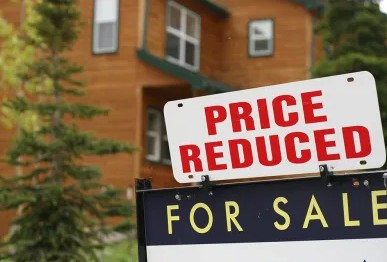
Higher-end homes continue to bear the brunt of Australia's housing downturn.
Although property values are declining across the country, the correction has been most pronounced in certain segments of the market, particularly at the upper end, where prices are falling at a faster pace.
According to research firm Cotality's September Housing Chart Pack, upper-quartile property values in Sydney and Melbourne are more than 10% below their peak levels, dropping 10.7% and 10.5%, respectively.
"While the market correction has become more widespread, the largest declines continue to be concentrated among higher-value homes," said Cotality's Head of Research Gerard Burg.
So what's driving the downturn at the top end of the market?
"The feedback we're getting is that buyers at the higher end are begging more cautious with rates going up," Claire Viskovich, founder, director and broker at Perth-based Beez Neez Finance, told Australian Broker. "They are getting more nervous about affordability and just, sort of, holding back a bit."
Viskovich pointed to a recent sale that illustrates the pressure on higher-end properties. A home that was initially listed for $1.7 million, ultimately sold for $1.535 million.
"We had to take a lower price for it," the broker explained. "The agent said that the buyers at the top-end, they're being more picky now."
She added that, whereas people at the top of the market can literally afford to be cautious and wait — perhaps because they're purchasing a second or third home — buyers at the lower end still need a home. Coupled with the housing shortage, that creates continued competition, helping to underpin prices.
All of this is happening against a backdrop of higher interest rates. The official cash rate (OCR) hit a 15-year high this September as the Reserve Bank of Australia (RBA) continues to grapple with elevated inflationary pressures. All of this is further reducing borrowing capacity for borrowers.
"I don't think we've seen the worst of it yet," said Shannon Ingram, founder and principal mortgage broker at Ingram Financial in Bangor, New South Wales. "Obviously, the budget changes were announced a good few months ago now. But this is supposedly the peak selling period now in spring. And I just don't think we've seen the full outcome of it just yet with interest rates potentially rising again next month. And I think that that's going to have a knock-on effect. There's a lot of people who are holding off selling or whatever. I just caught up with a builder client of mine recently and he was saying his inquiry levels have just dropped right off as well."
The slowdown, however, hasn't taken all buyers out of the market.
"I'm still seeing a strong appetite for first-time homebuyers," said Adele Andrews, director and broker at Melbourne-based Australian Property Home Loans. "There's still a lot of competition out there, and that sub-million dollar mark remains quite strong, because there's a lot of stock. And there's not the bargains out there that the first-time homebuyers are hoping to secure as a result of all this media coverage about the cooling market. And a rate hike certainly isn't going to help anyone, that's for sure."
Maryanne Elliott, mortgage and finance broker at Brisbane-based 360 Mortgage Solutions, agreed.
"I personally don't know that I would be rushing into a purchase on the higher end at the moment just because when the market starts to lose a bit of value, that's usually where it starts," she said. "I would be waiting to see, if I was upgrading, that the market leveled out a bit before I went and made any big purchase."
Elliott, who primarily works with first-time homebuyers, added: "We're still seeing first-time buyers wanting to get pre-approvals and they're still buying."
But not all brokers have had the same experience.
Amol Agrawal, founder and finance broker at Juice Finance in Bunbury, Western Australia, said with the changes to the negative gearing tax break, there are less investors at the lower end of the market, hence less competition. Shoppers have less pressure to move and can therefore take their time.
"The higher end has, kind of, sustained its values because they never went up at a pace which the lower end of the market did," Agrawal explained. "But the lower end has taken a big hit. Units or properties which were once advertised for $750,000 are going for $670,000, or $680,000. And the investors have disappeared. That was pumping up the lower end of the property market where, pre-budget, things that were listed for $650,000, were going for $680,000, $690,000, and so on and so forth. Now they are pretty much not moving at all."
The broker added that the shifting market dynamics are forcing industry professionals to rethink how they approach sales, with the balance of power between buyers and sellers continuing to evolve.
"It's challenging times for sellers and real estate agents," Agrawal said. "I wouldn't say it's scary. But now there's a lot more negotiation skills needed and happening."