Australia's inflation problem isn't going away anytime soon.
On Wednesday, the Australian Bureau of Statistics (ABS) released the latest consumer price index (CPI), revealing that both headline CPI and trimmed mean inflation are still above the Reserve Bank of Australia's (RBA) target inflationary range, and in some cases rising.
In the 12 months leading up to August, headline CPI rose to 4.0%, up from 3.5% in the year to July. Trimmed mean inflation — which many economists consider a better indicator of inflationary pressures because it strips out goods with volatile price changes — remained unchanged at 3.6%, the same as in June and July.
The biggest contributor was housing, up 5.7% in the year leading up to August, compared with an increase of 5% in the 12 months to July, on a seasonally-adjusted basis. Other contributors include transport, alcohol and tobacco, and education, up 5.6%, 4.9% and 4.7%, respectively. Costs of insurance and financial services rose 3.5% during the year.
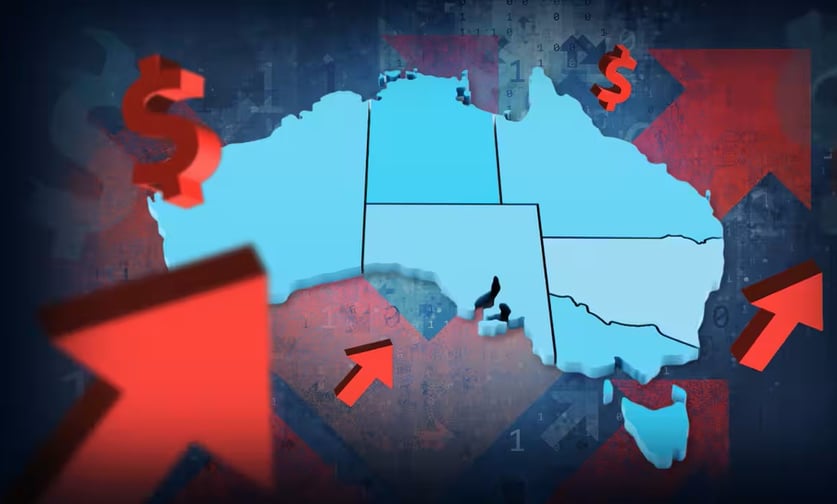
But housing prices weren't equal by city. In Adelaide, costs of housing rose 7.9% in the year leading up to August, the highest nationally. Darwin came in at a close second at 7.6%, followed by Hobart at 7.2% and Brisbane at 6.2%. Canberra, Perth and Sydney sat in the middle, with the cost of housing rising 5.4%, 5.5% and 5.9%, respectively. Melbourne had the lowest level of housing cost increases, up 4.5% for the year.
New dwellings prices were up 5.4% in the year, compared with an increase of 5.7% in July, thanks to project builders raising their base rates as a result of higher labour and supply costs. Electricity, meanwhile, rose 13.2%. That's on top of a 6.1% rise in July and primarily a result of the end of the Commonwealth electricity rebates. Rental prices were up 3.6% in August, unchanged since May of this year. Insurance costs rose 5.6% in the year.
By capital cities, Hobart residents have been hit with the highest inflationary pressures, up 4.8% in the year, followed by Adelaide at 4.7%. Darwin, Perth, Canberra and Brisbane also had levels up 4%, at 4.5%, 4.3%, 4.1% and 4.1%, respectively. Conversely, Sydney and Melbourne had the lowest levels of inflation at 3.9% and 3.5%, respectively.
The latest inflation data comes just one day after the nation's central bank raised interest rates for the fourth time in 2026, bringing the official cash rate (OCR) to 4.60%, its highest levels since 2011.
While widely expected, the news was met with dismay by mortgage holders and business owners nationwide, many of whom are navigating a number of headwinds, including rising living and supply costs.
The RBA has been adamant that it will not lower interest rates until inflation is back within the target band of 2% to 3%. At Tuesday afternoon's press conference, RBA Governor Michele Bullock added that the bank would raise rates again this year, "if that's what's needed to get inflation down."
"Our estimates suggest that it can take 12, sometimes, perhaps even 18 months in some sense, for the full effect of interest rates to come through," Bullock told reporters.
"We've got to see how these four interest rate rises feed through," the governor continued. "What we're observing at the moment, what we'll observe [on Wednesday], is, what's the point of the four interest rate rises? A number that happened a month ago. We're trying to look forward and we're trying to say, how are the interest rate increases we've done so far? What are they going to deliver for the economy in a few months' time and into early next year? That is the critical thing. Not the number, but what that number will confirm for us tomorrow — probably if it comes in on expectations — is that inflation in the first half of this year was unacceptably high."
More to come