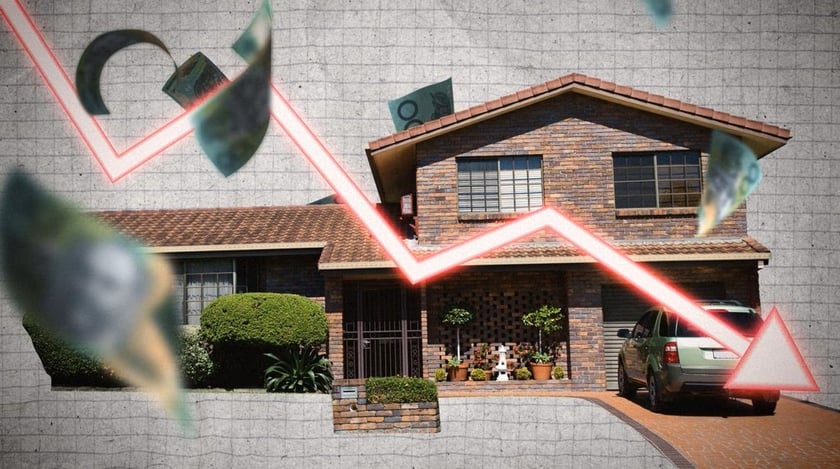
Rate pressure and shifting market dynamics seem to be hitting the housing market in every direction at once.
Inflationary pressures, higher interest rates, alongside warnings from Reserve Bank of Australia's (RBA) leadership, fewer first-time homebuyers entering the market, reduced demand for newly-built homes, a stubborn housing shortage, an updated budget and weaker investor activity are creating a challenging mix of headwinds for the housing market.
This week alone, reports came out that first-time homebuyer lending fell 20.1% nationally in August, year-over-year, according to Equifax's Consumer Market Pulse. The report signals continued caution among buyers and highlights the pressure facing prospective sellers. At the same time, the decline of demand for newly-built homes came into focus, with new home sales falling 10% in August, according to a new report from the Housing Industry Association (HIA). Investor activity is also subdued, despite lenders’ efforts to lure them back into the market.
"It's pretty bad out there to be honest," Andrew Hadjidemetri, director and finance broker at Australian Financial and Mortgage Solutions (AFMS) Group, told Australian Broker. "I think it's just going to get worse before it gets better. I don't think we've hit the bottom yet."
Hadjidemetri said in his own business, first-time homebuyer inquiries are down roughly 30% to 40% from where they were a year ago.
"There's just not much confidence out there whatsoever; it's just not there at the moment," the Sydney-based broker said. "But can you blame people? There's a whole mix of interest rates, inflation, the budget. First interest rates were going to drop, then they were going to go up. It's a bit all over the place at the moment. So it's a whole range.
"Investors are there. But, obviously, with the budget changes, they're impacted more than the rest," Hadjidemetri continued. "And with first-time homebuyers, it's just this level of uncertainty. They don't want to buy a property that's going to go down in value."
But the current environment does offer opportunities for brokers — and borrowers— if you know where to look.
"There's still lots of work out there. It's just a bit different work," Hadjidemetri said. "The conversations have shifted. But there's definitely an upside in the market. It's an absolutely perfect market for upsizing at the moment. It's also a good buying opportunity, the best buying opportunities I've personally seen in eight years."
In Brisbane, Maryanne Elliott, mortgage and finance broker at 360 Mortgage Solutions, said demand remains strong, with plenty of opportunities still available in the market.
"We're still quite busy, whereas some other mortgage brokers I talked to aren't," she said. "Predominately, we're refinancing our current clients. But also, there's lots of first-time homebuyers and buyers who want to get back into the market with the Help to Buy scheme."
The RBA has already raised interest rates three times in 2026, bringing the official cash rate (OCR) to its current level of 4.35%.
Earlier this month, Australia's five largest lenders all placed their bets on another interest rate rise before year's end. But any further tightening from the nation's central bank would add to the pressure facing mortgage holders and investors, many of whom are already contending with elevated borrowing costs, a higher cost of living and persistent inflation, new regulatory requirements stemming from the updated budget, a persistent housing shortage and continued uncertainty across global markets.
The RBA leadership team's recent public comments — including those from Governor Michele Bullock, Deputy Governor Andrew Hauser and Chief Economist and Assistant Governor Economics Sarah Hunter — have done little to help tame market fears.
Neither did the July consumer price index (CPI), which showed that inflation remains above the RBA's 2% to 3% target range, with headline CPI coming in at 3.5% and trimmed mean at 3.6%.
"Inflation is too high," Hauser said earlier this month, after Bullock herself said, following the August meeting, that "the board will raise rates further if that is what is required to bring inflation down in a timely way."
The RBA's next meeting on monetary policy is scheduled for the 28 and 29 of September.