A Commonwealth Bank of Australia (CBA) home loan approver has lost his unfair dismissal case after he told investigators he was “lazy to verify” a borrower’s payslip income, and insisted he had never heard of anyone called Hugo.
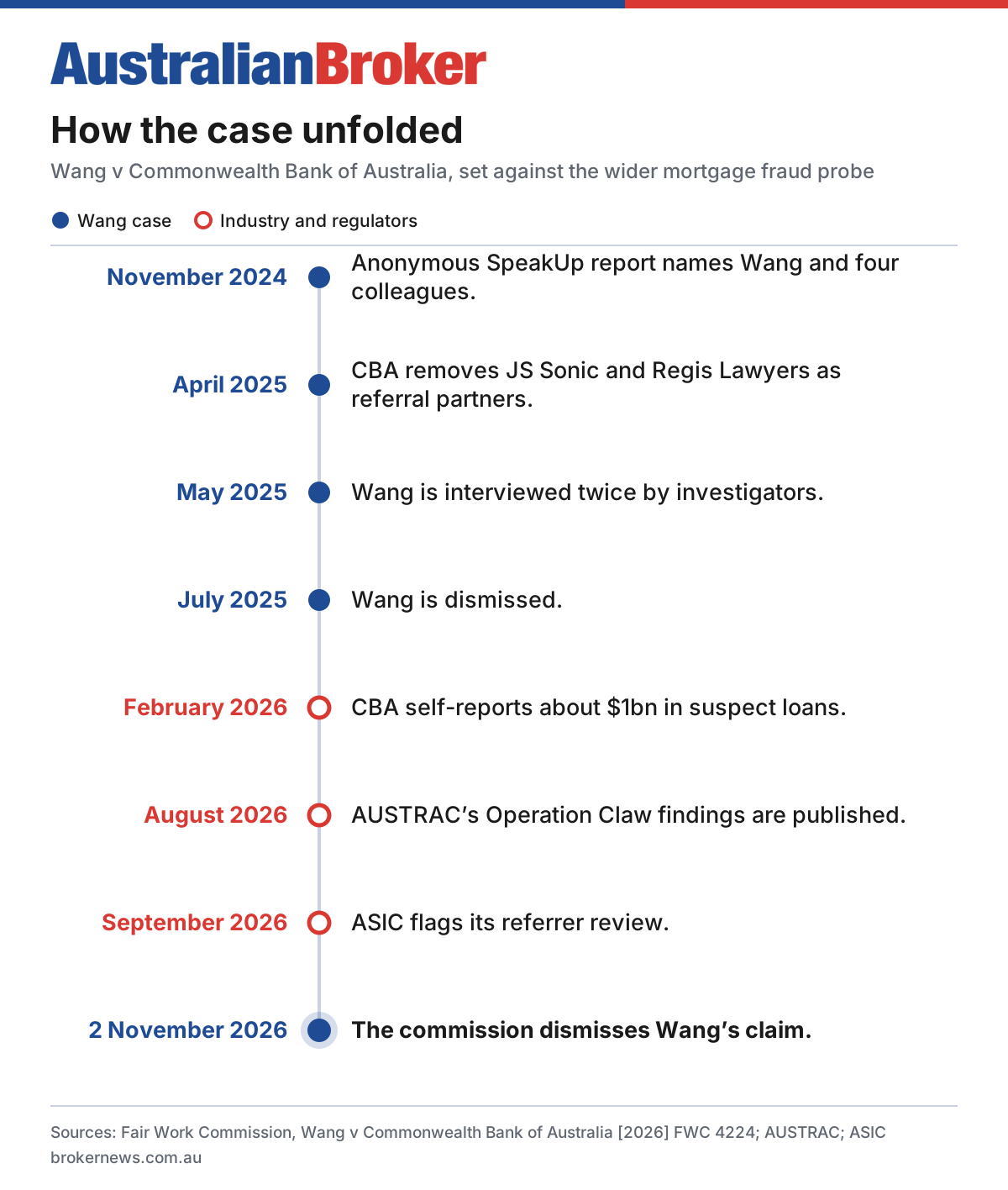
Deputy President Gerard Boyce dismissed Shun Wang’s application yesterday after he found that Wang intentionally misled the bank’s internal investigators and then “sought to intentionally mislead the Commission.”
This case adds to the picture of how bank referral channels can be gamed - those channels have been under close scrutiny since CBA’s February self-report sparked a broader mortgage fraud reckoning.
Wang was a Home Lending Executive, the most senior of CBA’s three lender grades, having joined the mortgage lender from St George in November 2020. By July 2025 (when he was dismissed) his base salary was $250,000, and he could earn a bonus of up to $200,000.
The case began with an anonymous report to CBA’s SpeakUp whistleblowing service in November 2024, which raised concerns about five staff. Although the original complaint against Wang went nowhere, a wider review of loans he had refinanced from St George appeared to show a concerning pattern.
Two of CBA’s accredited referral partners, JS Sonic and Regis Lawyers, had sent him a steady stream of self-employed borrowers. Many of those borrowers supplied company financials prepared by the same firm, Accountants Direct. Between them, the two partners referred 23 customers, which produced 35 applications and 28 funded loans.
Then investigators then looked at looked at the bank account of Zonghui “Hugo” Feng, who was not an accredited referrer. Between August 2023 and February 2025, the account received:
six payments totalling $81,146.44 from JS Sonic, described as fees;
six payments totalling $61,441.62 from Regis Lawyers, some labelled “referral fee”;
payments totalling $48,595.50 from five of the JS Sonic customers, around the time their loans were processed.
One customer told the investigators they had used a broker called Hugo Feng of Award Mortgage. CBA’s concern was that a broker was funnelling clients through JS Sonic and taking payments that resembled referral commissions. That remained the bank’s concern rather than a finding. Feng was not a party to the case, and the commission ruled only on Wang’s conduct.
Under CBA’s Referral Source Program, mortgage brokers and builders can’t take part “directly or indirectly” under any circumstances. While a loan is being assessed, only the bank’s business development team deals with the referrer. Lenders must not share customer information with referrers, because a bigger loan means a bigger commission for the referrer.
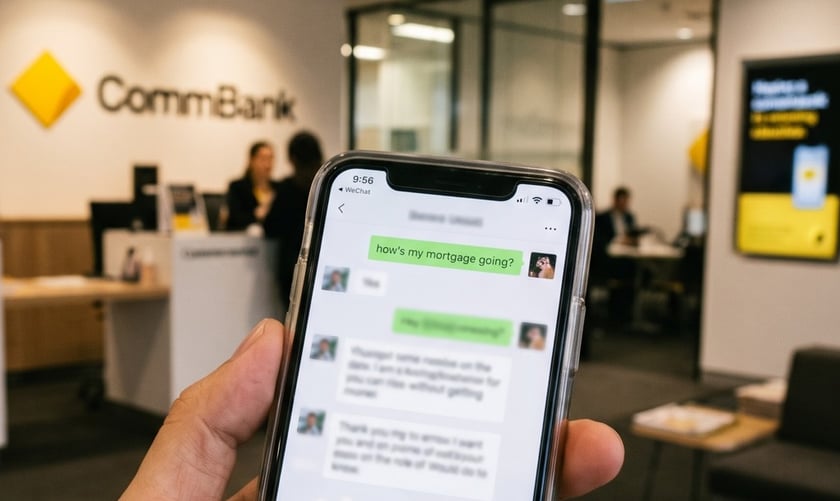
In the end, Wang admitted that Qin, JS Sonic’s approved referrer, had set up a WeChat group with Wang and Hugo. It was named after the company and he claimed started as a way to exchange Chinese New Year greetings. Over time it became the place where customer leads arrived, and where Wang told the other two whether loans had been approved or had settled.
By the time investigators asked for the chat, Wang had deleted it, also refusing to hand over his personal phone. Boyce said this meant what was actually discussed “will never be known.” He did not accept Wang’s claim that he had only shared loan approvals.
At his first interview, Wang said he had “no idea” who Hugo Feng was and knew no broker by that name – it was only when he was told to hand over his work phone did he mention that a customer called Hugo might be saved in it.
The forensic analysis of that phone found a contact named Hugo. The number was linked to Feng’s own CBA customer profile. One customer had texted Wang in Chinese to thank “you and Hugo”. Another wrote: “Hugo just told me that I sent you an email.”
At a second interview, Wang said Qin had introduced him to a Hugo years earlier, but that this Hugo’s surname was Hu or Zhang. Told the numbers matched, he said he had “nothing to say.” In his response to CBA’s show cause letter he offered a new explanation: he had only known the man as “Old Hu.”
Boyce found that the penny had dropped for Wang when his phone was taken, and that his lies then “only became more and more elaborate.” He called the Old Hu story “unbridled nonsense” and a “complete fabrication.” He described Wang’s evidence at the hearing as “a chaotic collection of lies, nonsense, poorly matched ideas, and manufactured responses.”
Wang also admitted leaving PAYG income out of two applications. He had approved the borrowers as self-employed, even though their bank statements showed regular wages. He told investigators he “forgot.” Later he said he had been “lazy to verify the PAYG income” because it was “hard to verify.”
Wang argued that his dismissal was harsh, partly because he has been placed on the Australian Banking Association’s Background Check Protocol list. Other banks may therefore learn why he was let go. Boyce rejected this argument, finding that industry lists of staff dismissed for proven misconduct help employers recruit. The financial and reputational consequences, he said, were “all on him.”
CBA removed JS Sonic and Regis Lawyers as referral partners in April 2025.
Australian Securities and Investments Commission has flagged a review of how lenders use referrers, covering banker incentives and broker oversight, due to start in the third quarter of 2026–27.
That follows AUSTRAC’s Operation Claw. Through its Fintel Alliance, AUSTRAC found a number of the same brokers, accountants and law firms recurring across suspect applications at 10 banks.
Brokers wrote a record 81.6% of new home loans in the June quarter, according to the MFAA’s State of Broking report. With that share, the whole channel wears the damage when cases like this come to light.
These are drawn from this case and are general guidance, not legal advice.
Treat any payment to a third party described as a “referral fee” or “service fee” around settlement as a serious warning sign.
Be wary of client financials that arrive by way of someone else’s email address.
Watch for one accounting firm preparing the financials for every client from a single referrer.
Check whether a “self-employed” borrower’s bank statements show regular wages. Declare and verify that income, however hard it is to verify.
Avoid group chats that mix referrers, third parties and bank staff.
Industry leaders’ advice applies: verify documents at the source.