
The mortgage market remained largely steady over the past week, with just a handful of lenders adjusting their rates as anticipation builds around the Reserve Bank’s next interest rate decision.
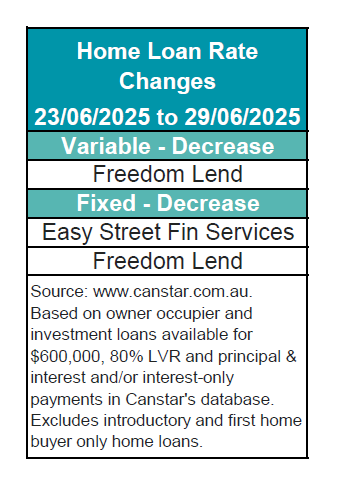
According to Canstar’s latest Weekly Rate Wrap-up, Freedom Lend cut four of its owner occupier and investor variable rates by an average of 0.96%, while two lenders cut 10 fixed rates by an average of 1.37%.
Sally Tindall (pictured above), Canstar’s insights director, said activity was subdued.
“The mortgage market has been particularly quiet over the last seven days with just one bank cutting variable rates and two lenders cutting fixed rates,” Tindall said.
Tindall said the recent economic data could be creating space for an RBA move.
“This is perhaps the calm before the RBA storm with the central bank potentially set to cut rates next Tuesday,” she said.
“Headline inflation is now just a fraction off the bottom of the target band, while core inflation is below halfway. This, combined with sluggish GDP figures, opens the door to further cash rate cuts – particularly considering the fact that the board considered a double cut at the meeting before in May.”
However, she warned that a cut isn’t guaranteed.
“That all said, if the bank doesn’t feel the pressure, it is unlikely to cut,” Tindall said. “Its preferred measure of inflation is the quarterly CPI results which aren’t due out until the end of July and Australia’s unemployment rate isn’t putting much heat on the RBA.”
New data released by the ABS last week showed the annual inflation rate fell to 2.1% in May, within the RBA’s 2-3% target band. The trimmed mean also slowed to 2.4%, down from 2.8% in April.
As a result, Commonwealth Bank and Westpac both brought forward their rate cut forecasts, now expecting the RBA to reduce the cash rate at the July meeting. CBA expects two consecutive cuts in July and August, while Westpac sees four cuts total, with rates reaching 2.85%. NAB also expects a July move, while ANZ remains an outlier, forecasting an August cut.
The average variable rate for owner occupiers paying principal and interest is 6.22%, according to Canstar.
The lowest variable rate available for any LVR is 5.24%, offered by Horizon Bank, specifically for first home buyers (excluding introductory and eco rates). For refinancers, Pacific Mortgage Group offers a starting rate of 5.34%.
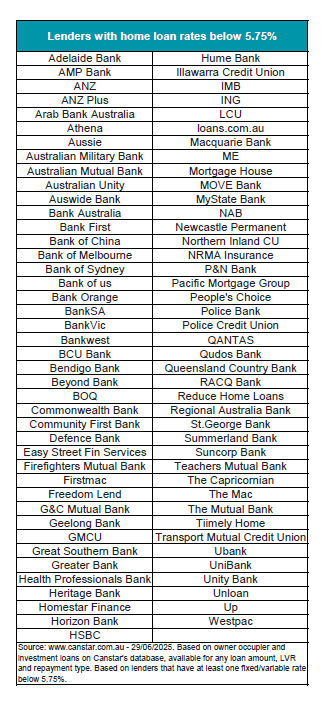
There are now 1,824 rates under 5.75% listed in Canstar's database – up from 1,809 a week earlier, indicating a marginal uptick in competitive options.
To compare the latest data with the previous week’s, click here.
In addition to the rate outlook, Australians are entering the new financial year with policy changes that could impact their finances.
“The new financial year opens some long-awaited doors for Australians, starting with the increase to the super guarantee from 11.5% to 12%,” Tindall said. “The super guarantee started back in 1992 at a rate of 3% to 4%.”
She said the change will particularly benefit younger workers.
“The change is particularly fantastic for young Australians coming into the workforce today who’ll benefit from the 12% rate for their entire working lives,” Tindall said.
Electricity bills are also set to rise – by up to $261 per year for some households – prompting more pressure on household budgets.
“The average household are on the rise by up to $261 in some cases over the next year but the government is going to take the sting out of some of it by extending the electricity bill relief by another $150, delivered in two more quarters, so expect $75 from 1 July to appear as credit on your bill and then another from 1 September,” Tindall said.
But she warned that won’t be enough for everyone.
“The problem is, for high energy households, that’s not going to touch the sides so it's well worth taking matters into your own hands by getting relief yourself,” Tindall said.
Canstar’s research suggests switching plans could deliver real savings.
“Our research shows that if you switch from an average priced plan to the lowest you could in some places save up to $300,” Tindall said. “That’s what I call proper relief.”