The housing downturn will run well into next year, according to Domain’s 2027 Forecast Report, released this morning. The report also puts its neck out and puts a rough date on the recovery, which few forecasters have been willing to do since the Reserve Bank started raising rates again in February.
Domain expects house prices across the major capitals to fall 10% to 13% from peak by mid-2027. Units should hold up better, with falls of 6% to 9%. Over the 2026–27 financial year, combined capital city house prices are forecast to drop 9%. Perth is expected to fall furthest at 12%, with Sydney and Brisbane at 10% each. Melbourne (7.5%), Adelaide (6%) and Canberra (5%) are forecast to fall less.
In the middle of the year, Domain was expecting a much milder FY27 result. Two more rate rises and the investment tax changes have since pushed its numbers sharply lower.
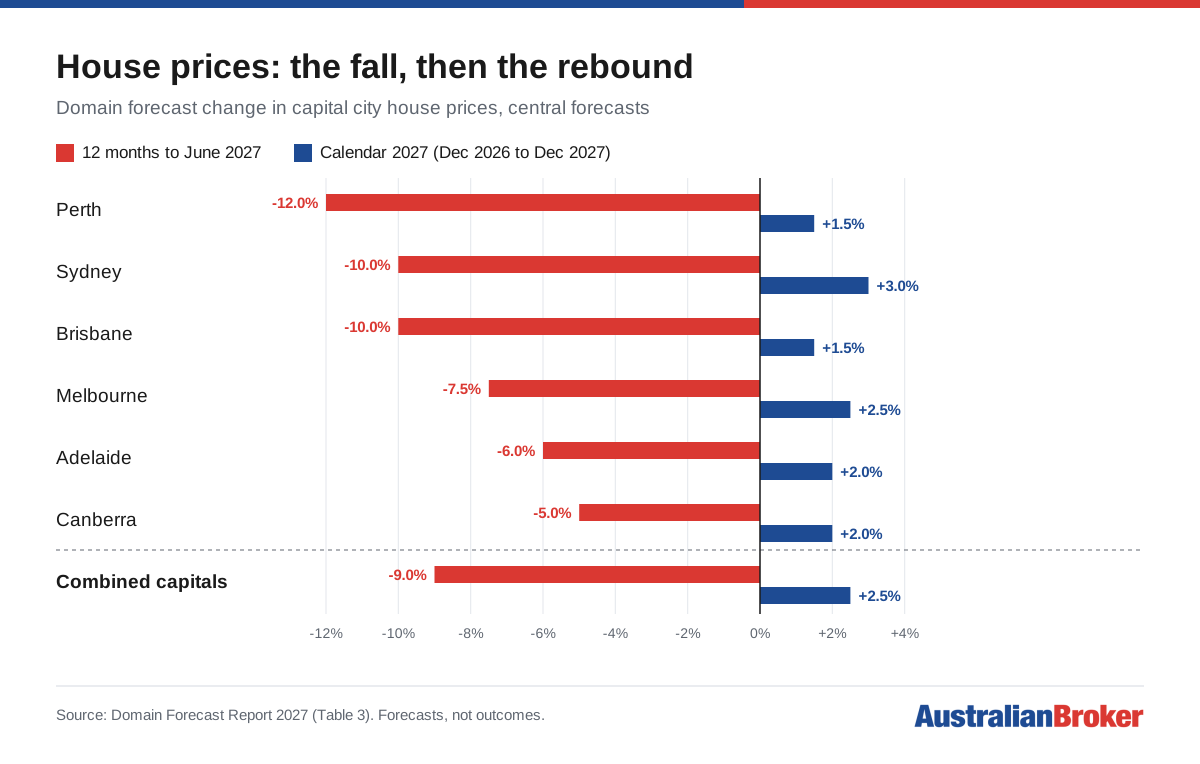
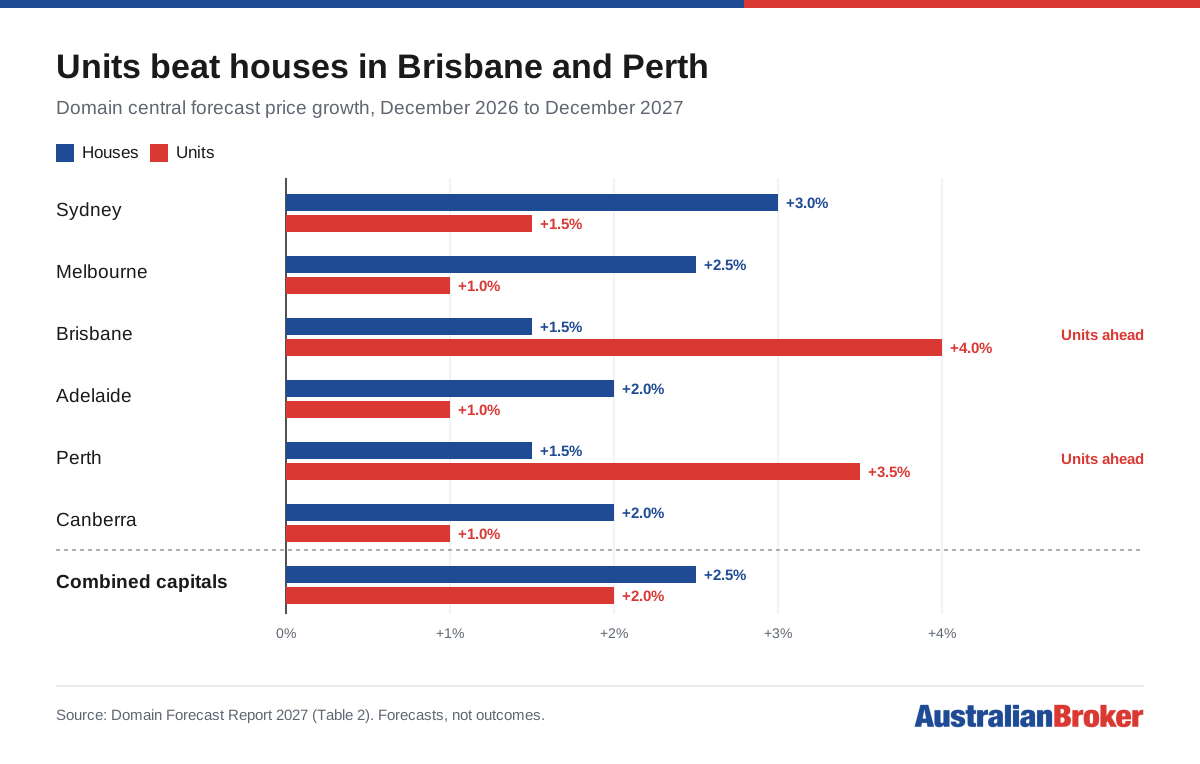
Domain’s central forecast has Sydney house prices rising 3% over calendar 2027, the largest gain of any capital. Melbourne is next at 2.5%, in line with the combined capitals. Adelaide and Canberra are forecast to rise 2%, and Brisbane and Perth 1.5%.
On Domain’s forecast range, Sydney’s median house price would sit between about $1.60 million and $1.70 million by December 2027. The city would remain the country’s most expensive housing market.
Domain says Sydney houses have more room to recover because they reacted more sharply to the downturn. The report also points to a long-running supply shortfall on the east coast. New dwelling completions in NSW, Victoria and Queensland are running about 14% below pre-COVID levels, based on Domain’s analysis of ABS building activity data. In the other states and territories the gap is about 1%, and national rental vacancy rates remain close to 1%.
ANZ economist Madeline Dunk expects a similar order of recovery. She told Australian Broker the bank now forecasts capital city prices to fall 13.5% from their March peak, with Sydney down about 15.5%. ANZ expects Sydney and Melbourne to lead the rebound because they respond faster to rate changes, with Brisbane, Perth and Adelaide lagging.
The picture is different for units. Domain expects Brisbane unit prices to rise 4% in 2027 and Perth units 3.5%, ahead of houses in both cities, as buyers with less borrowing capacity move to cheaper stock. Sydney units are forecast to rise 1.5%, held back by a large apartment pipeline and weaker investor demand.
The Reserve Bank lifted the cash rate to 4.85% on 3 November, its fifth increase this year and the highest level since 2008. Annual CPI inflation was 4.3% in September and trimmed mean inflation 3.6%, according to the Australian Bureau of Statistics. Both remain above the RBA’s 2% to 3% target band.
Domain assumes the cash rate has peaked and does not expect the first 25 basis point cut until the December quarter of 2027. CBA head of Australian economics Belinda Allen is a little more hopeful, pencilling in cuts in August and November 2027. Domain’s biggest downside risk is one more hike, which it says would reduce borrowing capacity again and push its forecasts towards the bottom of their ranges.
David Cannington, a senior residential economist at Domain, told the ABC that 2027 would be a “year of transition”, with smaller price falls than this year and the market steadying in the second half.
Domain treats the investment tax changes announced in the May budget as the one structural factor in the downturn. Everything else, it argues, is cyclical.
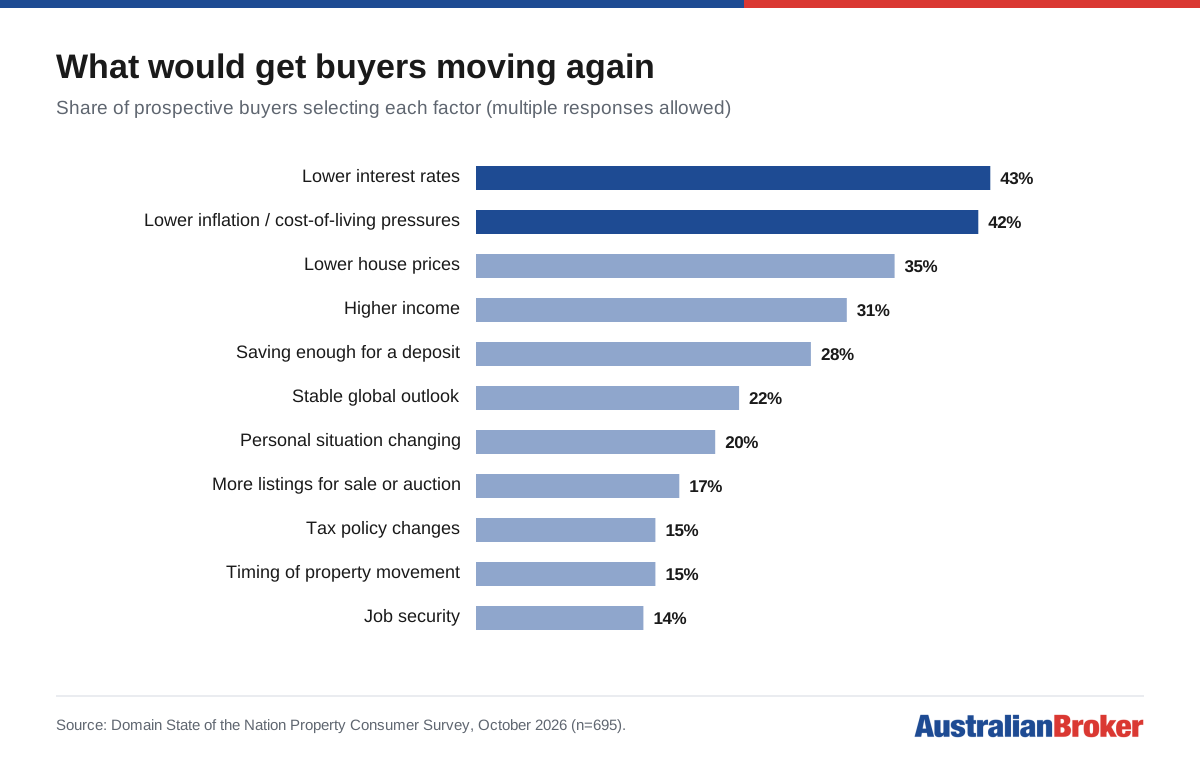
Domain’s October survey of 695 prospective buyers found lower interest rates (43%) and lower inflation and cost-of-living pressure (42%) were the factors most likely to get them buying. Lower house prices (35%), higher incomes (31%) and saving enough for a deposit (28%) followed. Only 14% picked job security, which suggests the softer labour market is not yet a major brake on demand.
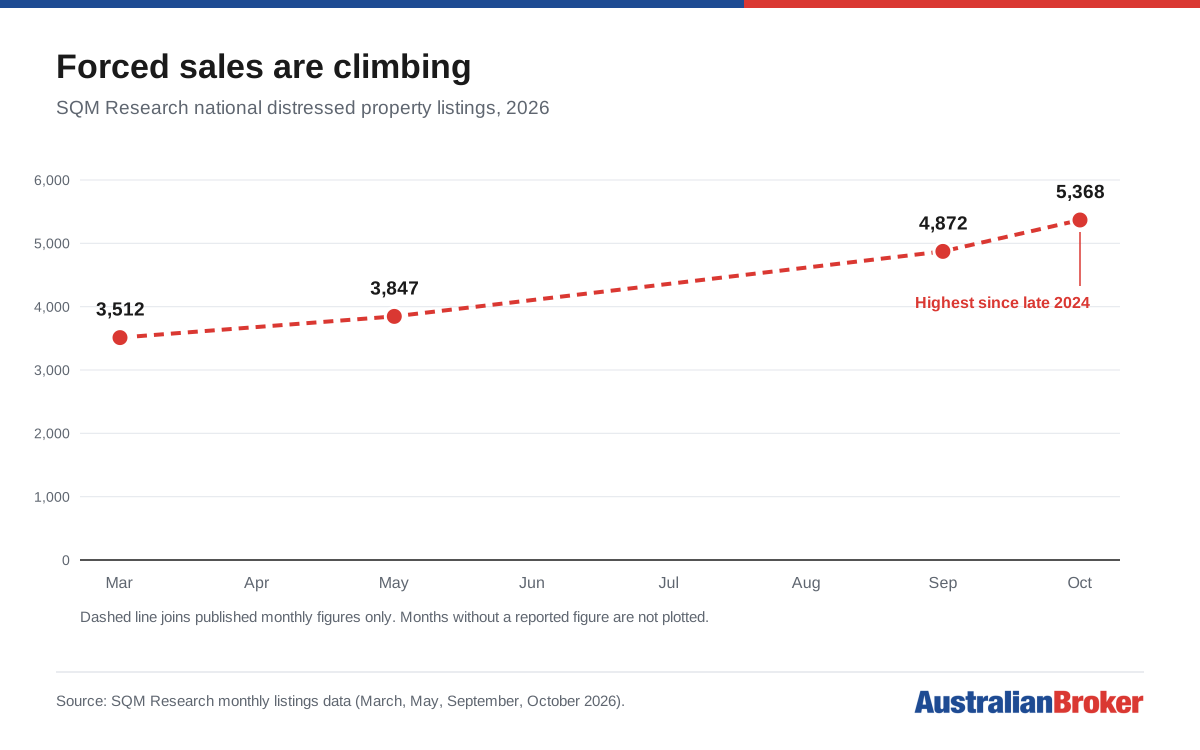
SQM Research counted 5,368 distressed listings nationally in October, up 10.2% on September and 42.3% on a year earlier. That is the highest level since late 2024, and it follows a 29% annual jump in September. Queensland has the most at 1,904. NSW rose 6.5% to 1,123, up 21% on last year.
The numbers are still small next to total listings, which passed 300,000 in October. SQM managing director Louis Christopher said the rise was what the firm was “watching most closely”.
Sydney agents told the ABC that price guides are changing almost weekly. Owners appraised nine to 12 months ago are being told their homes are now worth $50,000 to $200,000 less. Some buyers are waiting for further falls, though first home buyers and families looking to upsize are still active.
Brokers are reporting a similar slowdown. “I just think it’s going to be subdued for longer now,” Sydney broker Alex Ritchie, of Strategic Asset and Equipment Finance, said after the November hike. Data from mortgage technology platform Quickli shows refinances now make up about one in three deals, up from roughly one in four a year ago. Investor deals have fallen to just over one in four, and average debt-to-income ratios on approved deals are about 7% lower than last year.
Falling values will lead to more valuation shortfalls, particularly on refinances for clients who bought near the peak. Investor clients face higher repayments now and less generous tax treatment from July, so cash flow and rental yield will matter more in their decisions. With rates on hold for most of 2027, refinance demand is likely to stay strong.
Buyers with a deposit and a current pre-approval may be in the strongest position. If Domain’s timing is right, the months between the trough and the first rate cut are when competition should be weakest. While the RBA keeps another hike on the table, stress-testing clients for a further 25 basis points remains sensible.