Australia's home loan market has just suffered its sharpest quarterly fall since the ABS series began in 2002, with investors heading for the exits and first home buyers pulling back despite the government's push to get them into the market.
New figures from the Australian Bureau of Statistics show the number of new home loans fell 15% in the September quarter to 111,878. Their value slid 15.5% to about $81.2bn, the largest quarterly fall in value since the series began in 2002.
The slide has been building all year. New lending peaked at $108.6bn in the December quarter 2025, which means the value of new loans written has dropped by about a quarter in just nine months.
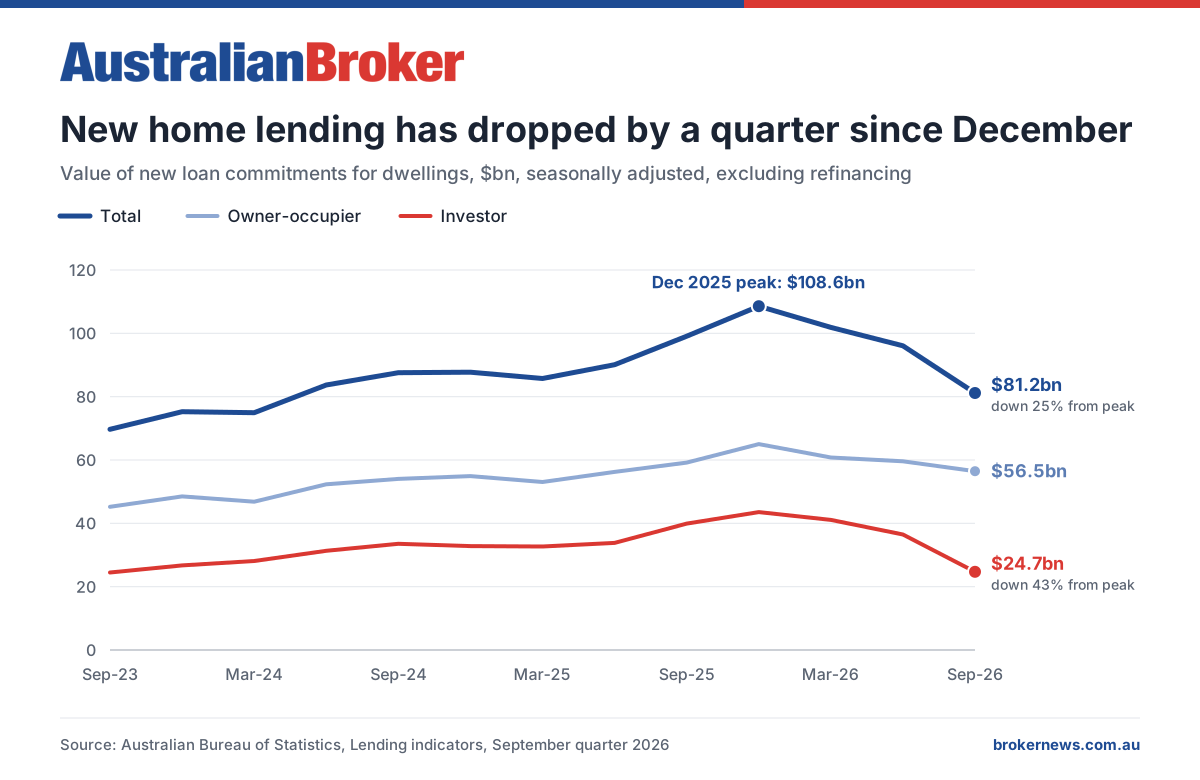
The retreat was sharpest among investors. New investor loan numbers plunged 30.6%, a drop the ABS said was almost double the previous record. It was the third quarterly decline in a row and the largest fall on record for both the number and value of investor loans, with sharp falls in every state and territory. The bureau pointed to the May budget's tax changes and expectations of lower house prices as well as higher borrowing costs.
Investor lending has now fallen by more than 40% since December, sliding from 62,450 new loans to 35,301, and the number of new investor loans is 38.5% lower than a year ago. Investors now take out fewer than one in three new home loans, down from around four in ten at the start of the year.
Owner-occupiers weren't immune either. Their new loans fell 5.3%, while first home buyer commitments dropped 8.6% in the quarter and now sit 12.3% below a year ago. First home buyers do still make up more than a third of owner-occupier lending.
Queensland drove much of the owner-occupier pullback, with new loan numbers down 10.4% in the quarter, ahead of Victoria (6.6%) and NSW (4.1%). That fits with Cotality's price data, where Brisbane has been leading the falls.
Housing Minister Clare O'Neil has seized on that rising owner-occupier share as an early sign the tax changes are working, saying more first home buyers are "winning auctions".
The ABS release has arrived on the same morning as Commonwealth Bank's first-quarter trading update, which told a similar story from inside the country's biggest mortgage book.
CBA's home loan applications were down 16% on a year earlier, with the bank pointing to buyer caution following the budget's changes to housing tax settings. Its home lending book still grew 6.6% over the year.
At the other end of the pipeline, more existing customers are struggling. The share of CBA home loans at least 90 days overdue rose 7 basis points in the quarter to 0.80%, its highest level in six years and up from 0.64% at the same point in 2019.
For brokers, the timing is worth noting. The quarter closed on 30 September, before the majors passed on the Reserve Bank's fourth increase of the year from 9 October, and a month before the Melbourne Cup Day hike that pushed the cash rate to an 18-year high of 4.85%. CBA, Westpac, NAB, ANZ and ING are passing that one on in full from 13 November.
Put simply, both the ABS figures and CBA's arrears capture the earlier rises only. The rest of the bill is still in the post.
CBA's bottom line is holding up for now. Cash profit came in at about $2.8bn for the quarter, 8% higher than a year ago and roughly flat on the second-half average, as lending and deposit growth lifted operating income 3%.
The bank did, however, book a $300m loan impairment expense, equal to 11 basis points of average gross loans and acceptances, and topped up collective provisions by $105m. CBA maintains that credit quality "remains sound".
Chief executive Matt Comyn said higher inflation and interest rates "continue to place uneven pressure on household incomes", although he described the broader economy as resilient, pointing to low unemployment and a solid investment pipeline.
It wasn't bad news across every book. Personal loan arrears eased to 1.66%, helped by seasonal factors, while credit card arrears held steady at 0.73%.
Home prices are still sliding
The lending slump is feeding straight into values. Cotality's October index showed home values falling for a seventh straight month, with national values 6.7% below their March peak and the combined capitals down 8.1%. Cotality says the pace of the decline is the fastest of any downturn in the past 40 years, with estimated sales over the past three months 23% lower than a year ago.
Forecasters have been chasing the market lower, with Westpac among the banks that have repeatedly cut their house price outlooks this year.
Fewer new loans, falling values and rising repayments make for an awkward mix, particularly for borrowers who bought near the top with thin equity buffers.
There's also a serviceability squeeze baked into the system. APRA lifted its assessment buffer to 3 percentage points in November 2021, yet cash rate rises since then now total 4.75 percentage points, according to Canstar figures. Many borrowers are now paying rates above the level they were tested at.
With purchase activity drying up, refinancing is likely to do more of the heavy lifting. Quickli head of data Amir Shareghi Najar told Australian Broker the latest increase is "likely to accelerate the refinance wave as borrowers chase sharper pricing".
For clients already struggling, the advice from lenders is to make contact early. CBA has said its support can include flexible repayment arrangements, and free financial counselling is available through the National Debt Helpline.
At leasts there’s a silver lining, higher rates are drawing savings into the bank. CBA's household deposits rose 7.7% over the year, and deposits now make up 79% of its total funding. Its CET1 capital ratio sat at 11.5%, and it has raised $14bn in long-term wholesale funding so far this financial year.
The next proper look at CBA's books will come with its half-year result on 10 February 2027, by which point the November hike will have had a few months to bite.