
Refinancing has become a much larger part of brokers’ work this year. Figures from mortgage technology platform Quickli show refinances now account for about one in three deals, up from roughly one in four a year ago. Investor deals have dropped to just over one in four. Average debt-to-income ratios on approved deals are about 7% lower than last year.
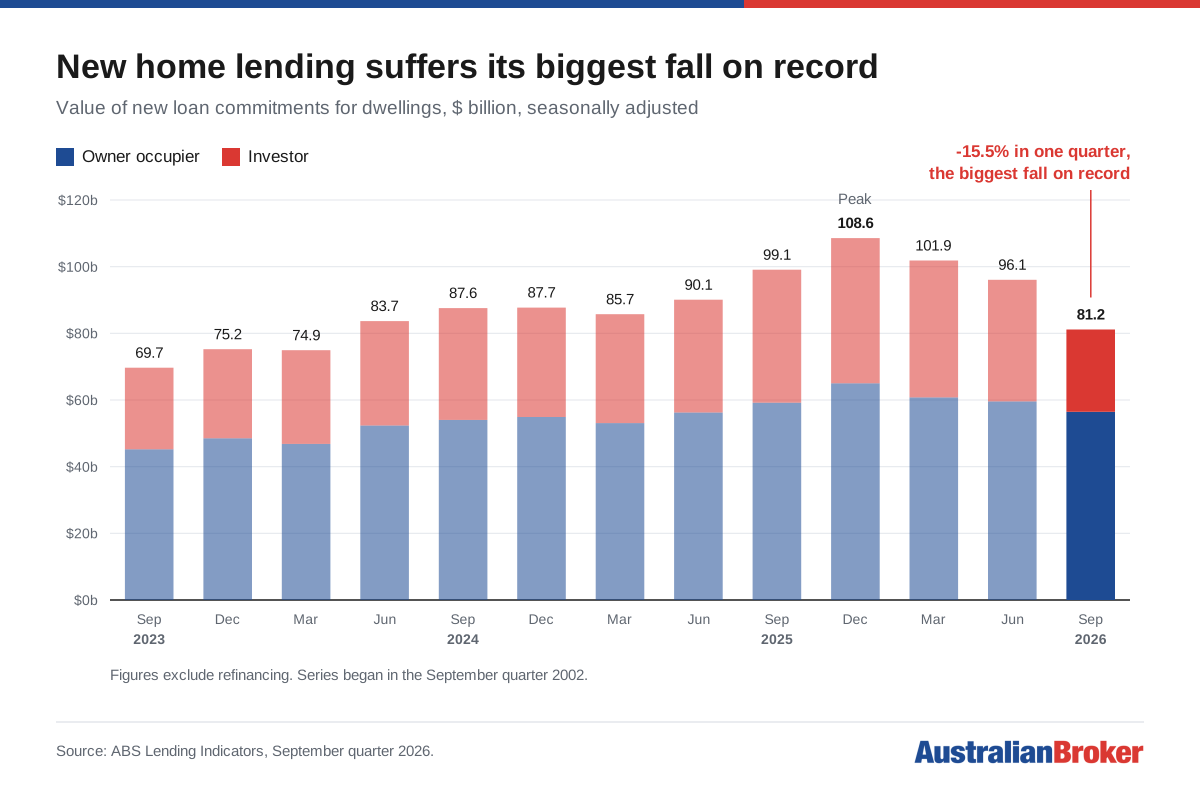
But that’s not a refinancing boom as the shift has more to do with the slump in purchase lending than a rush to switch. The Australian Bureau of Statistics has reported that the value of new home loans fell 15.5% to $81.2 billion in the September quarter, the largest quarterly fall since the series began in 2002. The number of new investor loans fell 30.6%, almost double the previous record drop, and first home buyer loans fell 8.6%. External refinancing eased too, with owner-occupier switches between lenders down 3.8% over the quarter.
ABS head of finance statistics Mish Tan said investors appeared to be reacting to more than higher borrowing costs, pointing to the tax changes and expectations of lower house prices. In other words, refinancing is a bigger share of a smaller market.
The Reserve Bank lifted the cash rate to 4.85% on 3 November, its fifth increase this year, and few forecasters expect relief soon. Domain’s 2027 Forecast Report, released today, assumes rates have peaked but does not expect the first cut until the December quarter of 2027. CBA head of Australian economics Belinda Allen has pencilled in cuts in August and November 2027.
Domain also expects capital city house prices to fall 10% to 13% from peak by mid-2027, before stabilising in the second half. Until then, high rates and falling prices are likely to keep many buyers out of the market. “Purchase activity is unlikely to turn until the market is confident the tightening cycle has peaked,” Quickli head of data Amir Shareghi Najar told Australian Broker after the November decision.
Repayment pressure gives existing borrowers good reason to shop around in the meantime. The MFAA estimated the November hike would add about $119 a month to repayments on a $731,000 loan. Mortgage Choice chief executive Anthony Waldron put the combined cost of the September and November rises at almost $180 a month on a $600,000 variable loan.
Serviceability is still the main obstacle. The MFAA’s August 2026 market sentiment survey found 49.2% of brokers had more clients unable to refinance because of serviceability, more than double the share six months earlier. The same survey found 96% of brokers had helped clients secure a discount from their existing lender, an approach many brokers now try first.
Falling values will make switching even harder for cash strapped clients. A borrower who bought near the peak with a 20% deposit could find their loan-to-value ratio pushed into lenders mortgage insurance territory if prices fall as far as Domain expects.
Sydney broker Alex Ritchie, of Strategic Asset and Equipment Finance, said brokers were focusing on refinancers and upgraders. That means staying close to existing clients, reviewing their loans for a sharper rate with their current lender or a new one, and talking through their plans for the next few years. FBAA chief executive Leo Gagic warned that changing lender policies, tighter serviceability and lower borrowing capacity were also putting pressure on broker businesses.
For brokers, a few practical steps follow from the data:
Refinancing will not make up for the volume lost on purchases. For the next nine months or so, though, it is likely to be where most of the work is.